Departure
"What about the language problem?" asked the princess when we were sitting in the train to Helsingör. "You've been there before. Is your Swedish good?"
"I get by like this," I said, "First I speak German, and if they don't understand that, English, and if they don't understand that, Platt, and if that doesn't work either, then I stick an "as" ending onto German words, and I find they understand that quite well." This was all we needed. She thought it absolutely wonderful, and immediately incorporated it into her lingusitic paraphenalia.
"So it's Sweden next. What do you think will happenas to us now in Sweden?"
Whatever happens on a holiday ... You, I hope."
...
"What shall we do now?" I asked, when we'd washed. All we could see of Stockholm from our hotel window was four chimneys agaisnt a blue sky.
"I think," the Princess said "we should first get an interpreter - your Swedish is excellent, quite excellent ... but it must be ancient Swedish, and the people here are so uneducated. So we should take an itnerpreter out into the countryside and find a very cheap little cottage, and we'll stay there very quietly."
From Michael Hofmann's translation of Schloss Gripsholm by Kurt Tucholsky
Any book, any writing, is always about language to some extent, and Gripsholm is full of linguistic play - Tucholsky was after all a satirist. There are some wonderful bits where Lydia, the princess, speaks in her native Platt as they set off on holiday from Berlin. Friends who speak this northern German dialect assure me that they can get by with it quite well in Denmark. Well these days in Scandanavia things are rather different to in the early 1930s and people take one look at us and start speaking English. I have to admit to struggling rather - it seems wrong to rely on English and I find myself suddenly quite fluently speaking the 5 and a half phrases of Dutch I have internalised over the years.
What I am enjoying though is the sliding spelling and pronunciation of words on street signs, in written form I understand more than I expected to. Of course it's also quite fun making up completely wrong translations, just to pass the time of day. Swedes, Danes and Norwegians seem to be able to speak to one another and understand each other fine - perhaps it's just like different dialects of English.
Thursday, 21 July 2011
Language and Tucholsky
Thursday, 14 October 2010
Couldn't resist taking this photo
 A wine called "the gospels" - what more could you want!
However I did not chcek whether this only held three bottles of synoptic wine or the full four gospel ...
Wednesday, 13 October 2010
My favourite holiday desert
 Quite often if the menu comes with desert I will share or offer mine to Dr B. He was however only allowed the merest taste of this one - a dark and white chocolate mousse eaten at l'Arboussier.
As one of my parrishioners used to say "ah a few seconds in the mouth, years on your hips."
More to ponder upon in this global week of action on food.
A holiday picture in preparation for blog action day
 So here's another photo from our holiday. This one reminds me of how on holiday I had time to take in life's curios, fun and decrepit things differently and appreciate them. Hey I even had time to photo things!
Because it's a dried up and out of use water pump it also reminded me of the work of the Ecumenical Water Network and of Blog Action Day this Friday which will be all about water.
Get blogging about water folk!
Crème brûlée - hmm yes please


Yes of course it was delicious - these two pictures just about sum up one part of the holiday for me.
Tuesday, 12 October 2010
A holiday picture a day - at least for the first week

To remind me of the lovely time we had and the privilege of time out and away from the rat race.
Fittingly this photo was taken at (one of) our favourite restaurants of the holiday - Lo Cagarol in Aigne with it's three course lunchtime menu at 13.50. Lo Cagarol is Occitan for the snail - hence the ammonites. (Well I think that's what they're called!)
Sunday, 10 October 2010
Final 48 hours of holiday - Olonzac, Lo Cagarol, Bize Minervois, Millau and Le Poivrier at le Puy en Velay

Bon appétit and here's to the next holiday ...
Friday, 8 October 2010
Occitan - the sound of the south, linguistic discoveries while wine tasting

In the window of the cave coopérative in Cessenon yesterday there was a poster for Occitan lessons - come and discover or rediscover how to speak, read, write, sing and laugh in the local language. You can find out more here. Occitan is really the sound of the south and we had quite an introduction to it listening to one of the wine growers we visited this week. Proudly Occitan and Mediterranean even in the grapes he planted and made his wine from and the methods used to ferment the wine.
Occitan in its written form traditionally tells of troubadours and ladies with unicorns, courtly love. It also often speaks of the Cathars, the religious sect wiped out following the Albigensian crusades. It's great to see Occitan going through a revival these days - for decades it was considered "dirty" to speak regional languages, now though you can even take Occitan as a baccalaureat subject.
Walking around Causses we came across a memorial to Jacques Vanière, not a writer in Occitan but a Latinist poet and Jesuit priest. The tiniest of villages yet this celebration of culture, language and poetry was at the centre.
Going around the villages in the countryside here, I am continually struck by the incredibly long and rich cultural and religious history. Human beings have been living, singing and versifying for millennia in this part of the world, so much of the languages from long ago is lost so it's good that there is renewed interest and commitment to Occitan. All the place names as you enter the towns and villages are in Occitan as well as in French.
St Chinian and Causses - different views on the same day

So here are some of yesterday's photos arranged here with the municipal cloisters in St Chinian in the centre. The next post will be of the same photos but with a different centrepiece, it's interesting to see how this changes the perspective. You walk through St Chinian's town hall to enter into the cloisters and with great French aplomb they've made a wonderful modern meeting room on one side of the cloisters. It works very well.
It makes me wonder whether what is now the town hall wasn't once a convent or religious house - it does rather have that sort of look about it. In all of the years that we have been coming here I've nover really wondered about that or looked further itno the history of St Chinian itself. Over many of the churches in other towns of the region you'll find the words "Liberté Egalité Fraternité" have been written, sometimes even with the addition of "propriété de l'état". This is a way of clearly marking out state power over the religious buildings.
Anyway, the rest of the photos are from the lovely little village of Causses which we visited to go and taste and buy some of the wines from La Maurine Rouge vineyard. We had great fun wandering in the streets and also discovering the wine we had first tasted at Cessenon on Sunday. More about that later.
Thursday, 7 October 2010
"Willows whiten, aspens quiver" - seeing details differently and having time ...
 One of the great things about being on holiday is having the time to take things in and appreciate them differently. Opposite the back courtyard where we're staying there is a lovely mediterranean pine tree in the middle of a village garden. It gives me simple but deep pleasure on the late sunny evenings to simplysit and look at it, to watch the play of sun-setting light turning the bark red, to see how the wind makes the outline of the pine leaves move across the blue and darkening sky.
Looking at the bark of the plane trees in the market square or along the canal du midi; seeing the random pattern of the shells on the beach; wondering at the continually changing movement of waves on the sand; seeing the way the leaves of the olive trees move and how the shape of the varieties is different; seeing the asparagus gone to seed in people's gardens and taking pleasure in the way the garlic is plaited and the pumpkins are piled up on the market stalls; seeing the vines changing colour and liking the newly turned ground - all of these things made me think of my irascible English teacher Dan Plim. (Sadly the only online trace I can find of him is his history of Redditch golf club (!) and details on Friends Reunited of his death two years ago.)
I remember him twirling his reading glasses in his fingers and encouraging us to note the poet's eye for detail as we were reading Tennyson's The The Lady of Shallot. The leaves of different varieties of tree behave differently in the wind "Willows whiten, aspens quiver". I was lucky enough to have both a willow and an ash tree in the hedge of the garden at home and so could test what the poet and my English teacher said. And I still get irritated with Dr B for not knowing his oak trees from his willows - though after 20 years in France he can just about spot a plane tree.
There is beauty in majestic landscapes, broad brush strokes and the big picture, but there is also deep beauty in the small almost insignificant details. Artists of the word or brush may capture them for us, Caneletto for instance. But for me this holiday time blesses me with leisure to enjoy details and wide views, to be restored by both and to take that transformative pleasure back into my everyday life. Dramatic sunrises or sunsets, a beautiful autumn leaf or a scurrying lizard searching for fading warmth amongst the rocks, sun from behind the clouds, all help to add a different dimension making life more poetic, less mundane and taking me out of myself. so even when the holiday is over, it won't be over - the poetics of plaisir, loisir et désir will be able to continue. "Pleasure, leisure and desire" was the title of a brilliant Bible study on the Song of Solomon by Jacques Chauvin. Wonderful title and a great holiday ethic it seems to me, more on that theme later.
From the Canal du midi near Homps

So for now here are some more images from part of yesterday's trip to the Canal du Midi. Apparently one of my (about 3) readers complained that yesterday's collage of the olives was not as good as some of the others. Well all I can say is I'm sorry, I'm just doing this for fun folks, I am not a professional artist or photographer.
Anyway, yesterday was a very full day - just the amazing Château Landure and the lovely Abbaye de Fontcaude to add now, but first another day of holiday to enjoy, not many of those left.
Wednesday, 6 October 2010
Olives galore, tasting the oil

After lunch and some gentle walking along the Canal du Midi and some pottering around the Capitainerie in Homps we set off for Cabezac and Bize Minervois where the Oulibo wine cooperative can be found. I had quite a fun time tasting the oils and choosing some to take back with us. Of course these days you can buy everything over the internet but you can't taste that way. I've chosen some Picholine and Aglandou oils as well as the ordinary oil the cooperative makes. I slightly regret not having bought any Olivière oil but it was so pronounced and peppery that I decided to stay with the other two for now. The Picholine was delicious on our salad tonight.

Well today is overcast but yesterday was the perfect day

Pictures from around the port of Sète - with our evening meal thrown in for good measure!
However books to read still abound, as do vineyards to visit and villages to discover. We'll see what the day brings, first some breakfast and a look in my rucksack to see what books I bought at Le Flo des Mots yesterday.
Tuesday, 5 October 2010
supper ...


Figs, melon, cheese, bread, ham and wonderful local viognier wine - the perfect supper at the end of the perfect day. A real blessing as the sun finished setting.
A flow of words and wine


I just loved this wonderful bookshop in Sète, which is also a wine shop an art gallery and a café. It's called Le Flo des Mots. What drew me in to the shop were the great letters hanging from the ceiling, then inside it was like lots of different shops for different kinds of books, and of course wine. There were handwritten notes about some of the books, work by local artists and a lovely café area at the far end of the shop for tasting the wine and trying out the food. It was lovely and of course I didn't manage to leave without buying a book, well two actually ...
Monday, 4 October 2010
Do walls have ears or words?
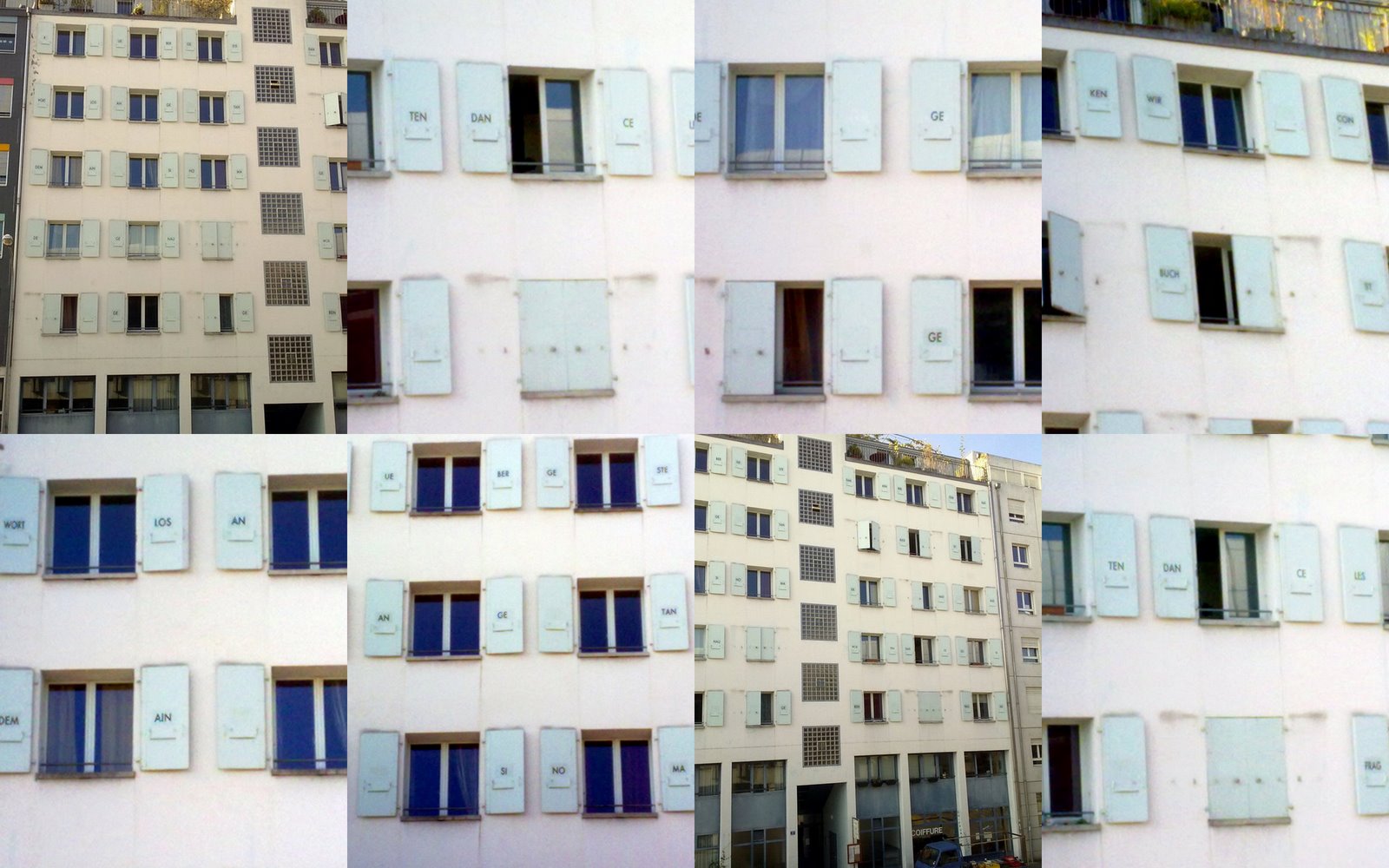
When we first moved to Carouge in Geneva over 16 years ago there was a wonderful local grafitti that went "Avant les murs avaient des oreilles, maintenant ils ont la parole!" That was before the age of digital cameras and I'm not sure we ever captured it on film but I still think it's one of the best pieces of grafitti I've seen: "In the past walls had ears, now they tell a story"
Opposite the main post office in Geneva are some great shutters which only have full words on them if both shutters are open - the other fun thing is that, this being Switzerland, the words are in both French and German. Unfortunately sometimes the shutters get painted and half of the word seems to get lost.
Anyway I think it would be fun to have one word on the shutters when they're closed and another when they're open - could be quite fun to make into an animated computer game actually. Each player gets a house and has to get the words on the inside and outside of their shutters - maybe you also get spray paint to paint over the words on your neighbour's shutters.
Update: Meanwhile Dr B prefers this translation "Before walls had ears, now it's their turn to speak". A translator has to always be open to revision.
A Sunday Collage from the Fete des Vendanges in Cessenon

You can see there is less blue sky on these photos, our holiday weather has turned more autumnal. We avoided rain at the wine harvest festival in Cesseonon and ate some great food at the Restaurant de L'Orb. We pottered around the village, tasted some wine, chatted to a really interesting woman who took over her parents' vineyard about four years ago. Her Parisian husband took over dealing with the vines and she moved from her job as an air hostess to take over marketing and promotion. It was agreat story and the wine was lovely. The wine is called Domaine La Maurine Rouge and their ordianry red is named for their children and called Ange ou démon. Angel or demon - as I said on my facebook update it tastes fiendishly angelic.
Sunday, 3 October 2010
On going to mass ... some jumbled up thoughts about ecumenism and other stuff
Last Sunday I admit I was fast asleep despite having intended to attend mass in the Roman Catholic Church here in St Chinian. But this week I managed to get out of bed in time. I should add that there are of course Protestant parishes in this area but none any closer than a 30 minute drive, so that would have take alot more planning - and required my driver to also be willing to get out of bed early during the holiday. So I went to mass. I wanted to be what I am whic is an ordinary every day Christian and see what it is like to worship with others in this small town.
I claim to come from an ecumenical background, yet the first time I ever attended a Roman Catholic mass was during the week of prayer for Christian Unity in Dunkerque about four months after my ordination. I am still rather shocked about this when I think about it - I had been to prayer services in mosques, synagogues, gudwaras, Hindu temples, yet not once had I attended a Catholic mass. To be fair I had been to many Roman Catholic services of prayer and I was taught Old Testament by a Dominican. Thinking about this now certainly makes me realise just how enclosed our different confessional communities can be, how ignorant we are of one another's life and how desperately or perhaps blissfully self-sufficient we can be. It isn't right and it isn't good for us either.
In Dunkerque on a January Saturday evening I was invited to preach at mass, the next day the Roman Catholic priest preached at the Protestant temple. What shocked me terribly as I took part in the mass for the first time was how terribly familiar it all was. Although I knew none of the responses in French I still somehow "knew" them and instinctively knew where the liturgy was going. At that stage I still did not have this instinctive feel about the liturgy of the Eglise Réformée de France, I was not as at home in it as I suddenly felt on that Saturday evening in the Roman Catholic Church. After I had preached, no doubt far too cerebrally, Jacques Duquesne, the wonderful priest in charge, invited me and all other Protestants present to stand with him behind the altar at the point in the eucharistic liturgy where the Lord's Prayer is said. I returned to my preacher's place and the liturgy proceeded and tears just poured down my cheeks. People were filing past me to receive communion and I knew that although I felt so "at home" in the liturgy I could not "communicate", not in that public role in that public place. In that moment I suppose the division of the church became real for me in the bread and wine I did not receive, I understood the brokenness of things. My hands and lips remained empty, my tears were uncontrollable.
Anyway this morning in St Chinian I had no public role I could just be there, take communion according to my own conscience, arrive and leave without saying much to anyone - apart from "la paix du Christ". This morning I felt part of things but also in some ways less at home - perhaps because the music was so unfamiliar. St Augustine said "to sing is to pray twice" so I suspect that this morning I did not pray twice. Nor was I edified by the homily but in itself it is always good for a preacher to listen to someone else and realise quite how soon my attention begins to wander!
The priest was I would guess younger than me (this certainly surprised me, the Catholic Church in France has a crisis of candidates for the priesthood) and attendance was really quite good, the large church was over a third full, the organ was good. It was lovely to hear the words of the liturgy and the gospel in the accents of the south. But I realised that I was one of maybe half a dozen folk of working age there. Apart from the two altar boys the only other child present was a baby being carried by his grandmother. The reality of much of the traditional church throughout Europe is that it is white haired.
I felt very moved as people walked forwards to receive communion, so many with sticks, having problems walking, with a friend or partner helping them. The people of God, work weary, bone tired yet walking forwards in praise, in expectation. And I too went forwards.
I'm glad I got out of bed. It was a useful reality check about who the church is in a community like this. I was glad to see a reflection by the bishop on the deportation of the Roms in the monthly bulletin, invitations to a Christian Mulim dialogue group and a poster to take part in the local Cercle de Silence. I left feeling a little sad, thinking surely these people too might have been offered a little more of a sense of joy. Perhaps I am as ever too judgemental.
Of course I am - like a good Protestant - still pondering and meditating two of the Bible readings: "For God did not give us a spirit of timidity, but a spirit of power, of love and of self-discipline." 2 Tim. 1.7
And the end of the Lukan parable "So you also, when you have done everything you were told to do, should say, 'We are unworthy servants; we have only done our duty.'"
Friday, 1 October 2010
Wine is a foodstuff! Today's collage from the circulade of Aigne

The tiny "circulade" village of Aigne is just so lovely - more than a thousand years old. The church in part dates back to before the schism between Eastern and Western Christianity.
Meanwhile the lo cagorol restaurant gave us an amazing lunch and my translation skills were useful for the visitors from the USA at the next table. It was really great to be part of school children, builders from the nearby construction site and tourists all eating the same wonderful food. Fine, honest, fresh and creative, but also straightforward and not in the slightest bit snobby.
Then afterwards we wandered out to see a local vigneron hosing down his press after harvesting and pressing the grapes and admired the play of light in the tiny village streets.


 Posts