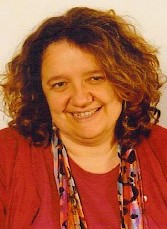
Following the chaos that was air travel yesterday I had a great night's sleep followed this morning by a fairly unsuccessful attempt to find my way around Calvin College campus where I'm staying for the Uniting General Council of the World Alliance of Reformed Churches and the Reformed Ecumenical Council (soon to be called the World Communion of Reformed Churches). Having found my way at last to breakfast (late and rather lost) and got some tea I then went to church.
Here on campus there is a very lovely modern chapel built in the round which is the home to the Woodlawn congregation of the Christian Reformed Church. The music during the service was very lovely and it was interesting to sing words I didn't know to tunes I did - I think I realised that I never had sung "Torrents d'amour" in English before. The congregation were very welcoming particularly of the large group of young people from around the world who will be staffing the conference which begins tomorrow.
A father and daughter were baptised as part of the service today, both adult and infant baptism within one family. It had been the baptism of his earlier child that led the father to take this step in faith.
It was reflecting on the meaning of baptism that led the pastor to choose the text from Revelation of the slaying of the dragon of evil and the battle between the forces of good and evil. He preached well on how baptism is not a protection for our children or for ourselves, how this goes against the culture of security that reigns in society. So we contemplated St Michael slaying the dragon and thought about the temptation of safety in our lives and our churches.
Earlier in the service I had been a bit surprised to hear the pastor explaining baptism as a way of joining the institution that is the church, not as a response to Jesus' call to follow him - interesting. It was also a useful reality check for me to experience ordinary Sunday worship in the more traditional part of the Reformed family. It was a very structured service, very pedagogical and instructional but perhaps not quite liturgical enough for me ... very pastor led. I think I would have liked the adult getting baptised to say a little more about his journey with Christ himself rather than simply replying to formulaic questions.
Afterwards over coffee I had lots of interesting conversations and sensed amongst many a real openness and understanding to ecumenical and other ways of living life as a Reformed Christian, as well as a certain reticence amongst others - shouldn't the church concentrate on saving people rather than on social action?
I sense that the new Communion of Reformed Churches which will come into being here in Grand Rapids will have to work hard to try to hold together confessional and faith concerns with the deep desire for social justice. Many of the churches in the Global South do this naturally - it's part of being a Christian, as is praying and bearing witness. Somehow in parts of Global North some churches seem to have decided to say that they are either liberal or traditional and assume that those on the other side either don't pray or read the Bible or don't serve the world or speak out prophetically on social issues. Perhaps one day we will understand that the body of Christ is bigger, more diverse, more open and more challenging than any of us have dared to believe. A place of security from which we can find the courage to overcome the temptations of safety.
Sunday, 13 June 2010
Beauty and the beast ... reflecting on Revelation 12 and the deeper meaning of baptism
Tuesday, 28 July 2009
Read about my friend Jet's Calvin rap
Youth rap with Calvin
A news feature from the World Alliance of Reformed Churches
John Calvin wore sun glasses and rapped his story to the tune of the popular music classic, "We will, we will rock you". Audience members, invited to write their own raps, produced comic songs about God's mission, Calvin's example and the singer's sense of calling.
There are voices which say that the church in Europe today is dying. But the energy and engagement on show at a recent youth event in Lyon, France - timed to coincide with the 13th Assembly of the Conference of European Churches (CEC) - exuded hope and expectation.
The eventdubbed Le Grand Kiff brought together some 1200 young people from France and abroad.(Kiffer means "to love something and find it cool.")
Organized by the Reformed Church of France, the youth programme (18-22 July) was designed as an introduction to the theme of the CEC Assembly: "Called to One Hope in Christ".
Five days packed with activities ranging from an exploration game in Lyon to rock concerts, film nights, group Bible studies and a wide variety of creative workshops, were geared to have this generation of 15-21 years express where they are vis-à-vis our planet, God, the church and themselves.
The programme included time for youth to explore opportunities to express solidarity with the world. Organizations like Scouting France, CIMADE, FAIR TRADE and OIKOCREDIT Lyon introduced themselves and their key themes through a range of simulation games and interactive workshops.
Sunday, 12 July 2009
Micheline Calmy-Rey on Calvin
You can read the full text of Micheline Calmy-Rey's speech at the Calvin anniversary on Friday evening here. Bien sûr c'est en français mes ami(e)s!
Mildness, murder and money-making?
 Here's the great poster from yesterday's Deutschland Radio Kultur event at the St Gervais parish hall.
The panel addressed various myths and realities of Calvin's legacy - meanwhile I was trying to tweet the event from Dr B's new Nokia5800. It's quite interesting to do this - listen to something in German and then tweet it in much shorter terms in English - good practise for consecutive interpreting! Will my tweeting take over from blogging? I'm not sure, I don't find it quite so satisfying so far but it is interesting to see how much and how little you can say in 140 keystrokes.
Meanwhile the brilliant Suzanne McCarthy has been writing about Calvin and Servetus, highly recommended.
Saturday, 11 July 2009
God or Mammon at the Calvin 500th?
 So here's the globe floating into place at the front of St Pierre's Cathedral in Geneva for the Calvin 500th anniversary service last night. We were treated to three choirs of different nationalities, fabulous organ music, great chamber music and pan pipes, and wonderful drumming - even accompanying the 16th Geneva Psalter version of Psalm 111. Not sure what either Claude Goudimel or John Calvin would have made of that but it was fun.
In the picture here Micheline Calmy-Rey who is the Swiss foreign minister can be seen addressing the congregation. Next to her in the red gown is the Geneva state official who even on hot days has to dress up and stand next to any elected politician speaking in public on official business - and that means even in church. It adds a bit of colour but it is a bit strange when you're not used to the local customs. It made me smile to have all of these politicians talking in church about how important the separation of church and state is!
We were also treated to a wonderful pithy 4 minute résumé of the Reformation in Geneva from Professor Michel Grandjean. But the real treat was the sermon which Laurence Mottier and Setri Nyomi prepared together. More about that in a later post but the text was Matthew 6.19-33 - Do not lay up for yourself treasures on earth ... you cannot serve God and Mammon. More photos to come.
Friday, 10 July 2009
A Picture for John Calvin's 500th Birthday

Calvin's 500th Birthday
 Tonight we go to Geneva's St Pierre Cathedral for the service marking the 500th anniversary of Calvin's birth.
Meanwhile every nightuntil July 26th in the Parc des Bastions where the Reformation Wall is, open air theatre Genève en flammes is being performed and the village Huguenot is open for business.
Seems quite fun that the Genevan Protestant Church has decided to mark Calvin's anniversary by doing a major piece of theatre!
Tuesday, 16 June 2009
Harry Potter and the art of slow translation
 Regularly I get asked for quotes on how much a document or book might cost to translate. It's a normal part of my job to do these sorts of quotes. Translation is an expensive business, life would however not be more interesting if we all spoke the same language. But the other really big problem is not money but time, often alongside a quote for money goes a quote for time "So how long do you think it will take?" is how these conversations begin and I say "hmmm you want it yesterday I suppose ... "
It's difficult to explain to people that translation takes time, that translators aren't machines and that if your text is more than 2000 words long it will probably take more than a day to translate. Then Harry Potter came to my rescue. As the books about the child wizard began to take off the later volumes were kept secret even from the translators until the day of the English publication. Even with all of the money that J.K. Rowling's publishers had available, and their army of proof readers, revisers and checkers - to say nothing of the money they had - it still took them at least 5 months to get the different languages out. It's an example that people seem to have at least some understanding for, after all we don't have quite such human or financial resources at our disposal. Nor unfortunately will much of what we translate get read by quite so many people.
I was thinking about Harry Potter and the art of slow translation while leafing through a new magazine we've got at home. It's in French but it's called Books - l'actualité par les livres. Many of the articles in it are longer book reviews translated into French from a variety of other langauges and it is a really brilliant read. I've just finished reading about "The Bloody White Baron" and noticed that the original English review was published in February this year. It takes time for things to get published in other languages, this is June's magazine.
Where books rather than just articles are concerned it can often take longer than just a few months to get the translation done. On Friday this week we'll go and eat with Edouard and Bridget Dommen. Edouard, who is a Quaker, is one of the translators into English of André Biéler's chef d'oeuvre on Calvin's Economic and Social Thought. The original was first published two years before my birth more than four decades ago. The good news is that getting the English translation done has inspired a Chinese publication which is now finished but looking for a publisher(read more in the Calvin special magazine in English here). Translation is a slow and hopeful process, often also a labour of love.
Monday, 15 June 2009
The paradoxes of Calvin's thought by François Dermange
At the Calvin event yesterday afternoon François Dermange who is dean of the Geneva Faculty of Theology and professor of ethics gave a brilliant 7 minute introduction to the paradoxes of Calvin's thought.
It was however one of those moments that was slightly unnerving as an interpreter, the speaker had sent two versions of his paper in advance, it had even been translated into English - just enough to lull you into a false sense of security. Then as he started to speak his text was projected behind him but in German, while I was listening to his voice in French and trying to interpret him into English. He didn't read his text at all but spoke freely on the 8 different headings he had developed and got rid of one of them on the way to make up time, I think 5 became 4 but we still ended up at 8 rather than 7. Fortunately he didn't change his headings so I just about managed to keep up (I have a recurring anxiety dream about interpreting philosophical and theological French and the word "rhubarb" coming out of my mouth!).
The 8 theses that Dermange developed on the paradoxes and underlying energy to Calvin's thought were:
Providence and Christology; Humanism and the call to holiness; Gospel and law; the Christian, acting and acted upon; the individual and the church; Idealism and pragmatism - the radical nature of ordinary life; Love and justice; Calvin saint or Prophet?
I found it helpful to think about Calvin's thought and work in terms of dialectical paradoxes but I particularly liked what Dermonge said about the radical nature of ordinary life for Calvin, it sort of helped explain me to myself if that makes sense:
"The Christian way must be lived by everyone where they are, in their family, their jobs, their political commitments. the radical nature of their vocation runs through ordinary life, simple things ..."
Sunday, 14 June 2009
Moritz Leuenberger on John Calvin and Calvin Klein
Moritz Leuenberger was the main speaker at this afternoon's Calvin event in the Temple de la Fusterie in Geneva. Leuenberger currently heads the Federal Department of Environment, Transport, Energy and Communications and has been president of the Swiss confederation. He's a member of the Swiss Social Democratic Party.
The son of a Reformed pastor, from Zwingli's home town of Zurich where a play has been put on to mark the 500th anniversary called "Calvinism Klein" - yes it's all about religion and underwear! Germanophone rather than Francophone Leuenberger claimed to feel rather daunted at being asked to make such an address in Geneva on Calvin, epsecially after discovering in one reference book he consulted that Calvin is considered to be the father of classical French, he nevertheless gave his speech in extremely elegant French. He managed to be self-deprecating, funny and show real understanding of Calvin.
He also made four key points based on his understanding of Calvin and of reformation:
We need to reform our lifestyle with regard to nature
We need to reform the chain of solidarity
We need to reform the market economy
We need to reform our values
He also played with the image of two US presidents standing in Berlin - Kennedy denouncing the moral bankruptcy of communism and then decades later Clinton standing on the same spot and saying "everything is possible". In our current financial crisis we know that the anything goes model of unregulated markets has not been helpful. "Immoderation and greed have come to figure as driving forces of our financial activities ... bankers have been found to be bandits ... it is in our interests to marry ethics and market."
Leuenberger's full speech will be available tomorrow in Le Temps and in the NZZ, in French and German respectively,
Throughout the afternoon I was struck by how often different speakers underlined the fact that Calvin was not a killjoy but passionately believed that justice was the expression of love. As a second generation Reformer he structured the church, set limits but also transformed society insisting on the importance of education, work and the economy. The other key idea that was underlined was how Calvin insisted on the sharing of power between several people and on transparency and good governance:
"Given the imperfection of human beings, the kind of government which is most acceptable is a model where several persons share power, supporting and admonishing one another." (Calvin, Institutes Vol. IV ch XX)
No women speakers at Calvin 500th anniversary event
I spent most of this afternoon interpretting for the official national celebration by the Swiss Protestant churches of Calvin's 500th jubliee. It was a fascinating, thought-provoking and in many ways brilliant event. I'll say more about what some of the speakers said in a later post.
However, when I finally got outside for the apéro (interpreting is thirsty work) my way to a wine glass was hampered by several women who wanted to talk to me about why there had not been a single woman amongst the speakers (of whom there were at least nine).
Little had I expected to post about women in the ecumenical future and then immediately afterwards attend an event that completely underlined the point about the need for the inclusion of women in the ecumenical present. One woman pastor also remarked that often that when there are no women on the panel then the ecumenical dimension doesn't get mentioned. Another woman who is her cantonal church's president and whom I had never met before, said in almost her first sentence to me "They have got to start listening to our bottom-up approach. This top- down approach isn't working if it doesn't take any notice of us."
To be fair the issue of Calvin and his favouring women's education etc. was mentioned at the event but in rather an embarassed half a sentence as suddenly the panelists realised that there was not even one woman amongst them.
I have been involved in so many church events where men mutter about and question "women only" space. When a space or event supposedly for the whole church just assumes that it's ok for it to be a men only space, this passes without a murmur. Fortunately at the worship following the event the preacher was a woman.
Saturday, 6 June 2009
Was Calvin more Catholic than Luther?
 That was the somewhat provocative question at the end of the second of two lectures- "Calvin et sa vision de l'Eglise" - by Pastor Alain Amoux to launch a Calvin exhibition at the Reformed church in Ferney-Voltaire (writes Dr B while Pastor Jane was in Rome meeting the UK ambassador to the Vatican). Alain Amoux pointed out that while for Luther the structure of the church was largely a matter of indifference, Calvin developed a highly structured theology of the church. (Ironically in the 19th century the position got reversed with Lutheran theologians more and more insisting on a high theology of the church and Reformed becoming more and more diverse, or as Amoux put it, "happy anarchists" as far as the church is concerned.) In part, suggested Amoux, Calvin took th
 e church more seriously than Luther because Luther died before the start of the Council of Trent, while Calvin was active in Geneva while the council was taking place - he was therefore consciously or otherwise developing an alternative to the ecclesiology being developed in Rome to reconquor a Protestantised Europe. In the first lecture - "Calvin humaniste" - Amoux traced the contribution of Calvin to, among other things, the French language, ironically largely overlooked today in the "catho-laique" France. Calvin started off in a brilliant career as a writer and administrator and became a theologian of the church largely by accident, through the force of events.
Friday, 5 June 2009
Calvin, Gilead, Home and the Orange Prize
 A friend who had been attending Geneva's Calvin 500th anniversary celebrations last weekend, tipped me off to Andrew Brown's interview with Marilynne Robinson who has just won the Orange prize for her book Home.
I've not yet read Home but enjoyed her previous book Gilead alot so I'm glad to have a new book to look forward to.
Here are some quite extensive extracts from Brown's post - he interviewed Robinson when in Geneva last week, his proposed radio programme about Calvin sounds very interesting, but we'll have to wait for that.
There are two remarkable things about Marilynne Robinson, who won the Orange Prize for fiction: she's a very good writer, and she's a very serious Christian. Her two most recent novels. Gilead and Home, have retold the story of the Prodigal Son from different viewpoints, set in a small town on the Iowa prairie in 1956. "Retelling" is not what you think when first you read them; then the overwhelming effect is of being told a story, and hearing a voice, for the very first time. But both are, in fact, books about the workings of grace in human life, just as Brideshead was. But they are Calvinist, not Roman Catholic, and their pleasures are very much more humble ...Calvin gets such a bad press for being a killjoy, closer of the theatres etc., that it's more than a little refreshing to find a modern novelist talking in other terms about him and about grace.The link between joy and beauty and the apprehension of God is one which is very vivid in Robinson. I interviewed her last week in Geneva, as part of a Radio 3 programme I am presenting on Calvin (Smashing the Idols goes out on August 30); and she gave an extraordinary justification of Calvinist Christianity as making possible the modern novel.
"One of the things that has really struck me, reading Calvin," she said then, "is what a strong sense he has that the aesthetic is the signature of the divine. If someone in some sense lives a life that we can perceive as beautiful in its own way, that is something that suggests grace, even if by a strict moral standard ... they might seem to fail."
As we were queuing to sign the visitors book in the staircase outside the British ambassador's this evening I found myself humming Psalm 8 in French from the Geneva Psalter (a little touch of Protestant resistance in Catholic Rome - and it is a lovely melody, I particularly like tous les poissons sur les chemins des mers) - Robinson mentions Calvin's translation of Psalm 8 towards the end of Brown's post.
Meanwhile you can also read an interview from a rather different perspective with Robinson by Emma Brooks here.
And Dr B has contributed this link to Marilynne Robinson's book of essays, "The Death of Adam", which include the theology of Calvin and the hstory of the Puritans. As the review in the New York Times put it, "Puppet theories of human nature are always out to dissuade us from thinking words like nobility, honor, courage, loyalty, love and virtue actually mean what the dictionary tells us they mean. Robinson urges us to take another look." Another review states,
Perhaps the most serious charge against Calvin by his modern detractors is that he was ashamed of the human condition, that he denigrated our common humanity. Robinson meets this criticism honestly and head on. She points out that Calvin's attack on his own humanity and on our common humanity arise from his exalted view of what we human beings were created to be and are capable of be coming. His apparently dark assessment of human nature can be understood only in light of the dialectical relationship between our sinful nature and our nature saved by grace. Rather than being "inhuman and world-hating," Calvin's theology is quite the contrary. His description of our fallen nature is given only for purposes of contrast to our saved nature in Christ.
Sunday, 31 May 2009
Jean-Jacques Bauswein's 65th birthday
 The Stranzblog is currently on holiday somewhere in the Jura near Champagnole to mark our friend Jean Jacques Bauswein's 65th birthday. It's a wonderful fun weekend with extraordinary cultural and not so cultural discoveries. We bought delicious home-made jam from two women who have set up a small cooperative selling fruit and aromatic plant products, grown either in their gardens or collected from the surrounding countryside. We visited Emmanuel Jobez' Villa Palladian in Syam, and St Claude's Pipe museum. We took the "train des hirondelles", relaxed, got to know others in the group, ate great food and then heard the answers to the quiz we were all supposed to have taken part in beforehand. Stranz/Brown incorportated got "nul points", but still got a prize. I have enough problems understanding cryptic clues in English let alone French.
There is no internet connection where we are staying so you are spared daily updates on our activities. This morning we got up early as I had to interrupt celebrations to lead worship for Pentecost in Ferney as several of our young people got confirmed this morning. It was powerful and moving to hear them confessing their faith, my colleague Bernard preached very well on the Emmaus Road text and afterwards we gathered for drinks and photos garden. I caught up with lots and lots of news from people I hadn't seen for many years, happy and sad stories vivified by the Spirit.
Meanwhile Dr B has been covering the big service to mark Calvin's 500th birthday from the Cathedral in Geneva. It was broadcast on Eurovision this morning. Must see if I can download it or watch it.
In a moment we will head back to the mountains for some wine-tasting before a festival meal at which Dr B will for the first time in his life wear a DJ and bow tie - yes this party even has a dress code. More when we're back and recovered from wine-tasting and assorted festivities. Photos will follow.
Wednesday, 27 May 2009
And now for the Calvin celebrations
Well Geneva is an international city, so it's only fitting that a journalist from a British newspaper should come here for this weekend's Calvin celebrations. More surprising is that Andrew Brown has travelled to Calvin City to write about the Chinese. Very interesting and I look forward to reading more from him as the week progresses.
Saturday, 3 January 2009
Read Calvin with Princeton or eat chocolate and drink beer ...
Hat tip to Ben Myers for the link to Princeton Seminary's website inviting people to mark the Calvin anniversary year by reading the institutes. Apparently there's also a Facebook group and you can download the readings with iTunes.
Meanwhile I suppose it had to happen but the Calvin chocolates have made it onto Ship of Fools Twelve Days of Kitschmas. This may be because Ship of Fools are not yet aware of the Calvinus beer.
Meanwhile I just hope the Calvin09 site will soon get a bit more up to speed with things.
Anyway if you want to know more about Calvin go here and follow the links to read and listen to Theo Gill's lecture on "So who was John Calvin?"
More bits of trivia about Calvin here.
Friday, 2 January 2009
The Calvin year and other people's new year's resolutions
I did wonder whether at the beginning of the année Calvin I shouldn't set myself a completely unachievable task - like reading the whole of the Institutes or something. Then I wondered whether I should read more of Paul's writings as 2009 is also the year of St Paul. Dr B was once a bit of a lay expert on what are referred to as the writings of Paul so that could even be a joint project - but he seems to be more interested in the aesthetics of Berlin architecture at the moment.
There are of course many other resolutions I could make - keeping the house tidier, learning to be happier, eating more healthily, trying one more time to get the work life balance sorted out and lots and lots of other self-improving and life enhancing ideas. However, I have decided this will be my own year of living vicariously on the blogosphere through other people's new year's resolutions. Because you see other people have begun the New Year with all sorts of amazing projects.
David Ker has managed both to redesign Lingamish and launch a sort of tumble drier sort of blog which has a great post-modernist approach to posting all those bits and pieces you find while you're out there on the information super highway but don't quite know what to do. Why throw the html crumbs to the birds when you can turn them into a random intriguing blog? (NB Dr B while you read this over your morning coffee I think we could do with one of these sorts of blogs even if it doesn't dry the clothes.) Anyway the redoubtable Mr Ker is about to return to Mozambique and you can also help support Wycliffe Bible translators and his work with them by clicking here.
Meanwhile J.K. Gayle having got his doctorate has now also launched a fascinating new blog to go alongside the already mind-altering substance that is Aristotle's Feminist Subject. The new blog called The Wombman's Bible has the project of translating the Hebrew Bible from the Greek texts. The way I've written that maybe doesn't sound quite right but even non-translators may have heard of the Septuagint Greek translation of the Hebrew Bible which was often the basis for many later translations - and mis-transanslations. It's going to be fascinating to see how J.K. and his family get on over the year. "This blog is to be my ongoing commentary on the Bible. I'm trying to encourage myself and my family members to read it again this year. My daughters and my son and my wife are going to help me translate it into English. They're mainly going to read it in English. I'm mainly making it into English from Greek."
I was also intrigued by the Better Bibles Blog's invitation to join in this Bible reading project
which is also on facebook.
So many projects, so many great ideas. Meanwhile ... well meanwhile there is just so much to read, so much to learn about, so many links to be made, so much lurking on other people's sites to be done. I'm looking forwards to benefitting from other people's new year resolutions.
Tuesday, 18 November 2008
A calligraphy exhibition by Bridget Dommen

"It is nowhere forbidden to laugh or to eat one's fill or gain new possessions or enjoy oneself with musical instruments or drink wine."
On Monday evening we got to see the originals of Bridget Dommen's calligraphy of Calvin quotes that are in the 2009 Calvin calendar for the 500th anniversary of Calvin's birth next year. The originals are all beautifully framed and there are also cards of the different quotes available. The exhibition is on in the entrance foyer of the Ecumenical Centre in Geneva until Christmas.
It's all part of an attempt to try to reclaim Calvin from the prejudices about him which have grown up over the centuries.
At the "vernissage" - which is the wonderful French word for an opening night of an exhibition, meaning a varnishing, as in the varnishing of oil paintings - Douwe Visser, spoke both wittily and powerfully about the impact of Calvin's actual words - he even said he saw Calvin as his liberator.
When our communications secretary John Asling asked me last week to say in two sentences why the Theology Office of the World Alliance of Reformed Churches is doing an exhibition on Calvin, I had to think hard. Of course, it is obvious that the World Alliance of Reformed Churches has something with Calvin, especially in the Calvin09 year when the 500th anniversary of his birthday will be commemorated. No one can claim ownership of Calvin but as the largest global organisation in the tradition of John Calvin the World Alliance of Reformed Churches will most certainly be involved in this Calvin09 year. But still: why this exhibition?
Well, personally I see Calvin as my liberator. He made my Sunday life much happier. Let me explain. As a kid I grew up in a very orthodox reformed family in the Netherlands. Sunday life was going to church twice, in the morning and in the afternoon. No outdoor activities were allowed, except a short walk. I was a keen soccer player but to play that on Sunday was definitely not allowed. And oh how boring was that long, long day. The soccer ball in my room became so attractive. Yes my friend next door, he could play soccer on Sunday but he was Roman Catholic and my father used to say, that they could confess their sins and could continue after that as they liked. Well, I was prepared to confess all my sins if only I could go and play outside. But then on one of those Sundays the word of liberty came. Right from the pulpit in our church. It was during an afternoon service when our minister preached about the fourth commandment, about the Sabbath. He told the congregation in his sermon that we should not be too strict on Sunday because John Calvin himself in 16th century Geneva was now and then sailing in his boat on Sunday! This was a word for me. A word of salvation! The name John Calvin would be forever in my memory. And after the service I asked my mother whether she had listened well to the service. Of course she had. And oh how wonderful were the days when the word of the preacher still had great authority: the Sunday regime in our house became less strict. Thanks to John Calvin, sailing on the Geneva Lake.
You can read the full text of Douwe's speech here. Douwe works at the World Alliance of Reformed Churches as secretary for Theology and Ecumenical Engagement.
:: 2009 Calvin calligraphy calendar, price 15 Swiss francs (10 francs for orders of more than five copies), available from WARC, 150 route de Ferney, PO Box 2100, 1211 Geneva 2, Switzerland, Fax: +41 22 791 6505, Email: warc@warc.ch
Order online at: http://warc.jalb.de/warcajsp/
Monday, 17 November 2008
So who was John Calvin? Neither a saint nor a murderer - or maybe a bit of both?


Tuesday last week saw the launch of a short series of lunchtime library conversations. Theodore Gill got us started with a brilliant lecture called "So who was John Calvin?"
Theo began by showing us some of the cartoons of Calvin you can find in the Calvindrier that The Protestant Church of Geneva has published for the 500th anniversary of Calvin's birth.
So, who was John Calvin? La Vie Protestante, the magazine of the EPG or Protestant Church of Geneva, offers us one answer to the question. As the headline of this month’s editorial tells us, Calvin was Ni un Saint, Ni un Tueur – neither a saint nor a cold-blooded killer. It seems a rather negative assertion – attempting to explain what he was not, and quite defensively, rather than who he was. I prefer to commence in a different way…
I advance the proposition that John Calvin was very much a creature of the sixteenth century – a product of the high middle ages as they intersected with renaissance, a humanistic scholar whose academic concentrations had been in the fields of classical literature and law. But the basis of all education in those days was theology, and it was to this discipline that Calvin returned in earnest after he had completed his studies at the Collège de Montaigu in the University of Paris and made his way to the city of Basel.
The concomitant point I’m trying to make is that we are not creatures of the sixteenth century, not even the most Reformed among us, nor the most Lutheran or Anglican or Mennonite or Unitarian or Jesuitical. Our post-Enlightenment orientation and assumptions are so different from those of Parisians in the 1530s or Genevans of the 1550s that we do well to put a historical spin on the injunction, “Judge not, that you be not judged.” We lack the existential basis for judging 16th-century ancestors in the faith. To know John Calvin, much less to render judgment, we first would have to borrow a page from C.H. Dodd and enter into that alien era of Calvin, and Farel, and de Bèze, and Servetus, so as to live ourselves into its strangeness, and then return to our present. This is not likely to happen over one lunchtime, but let us try to go a few steps of the way.
The lecture was a birlliant reumé of Calvin's life and theology. Now you too can benefit from our lunchtimes in the library. The podcast and full lecture can be found on the website of the Ecumencical Centre Library (click on the links), and you can browse their site for other nuggets of fascianting information, a truly wonderful resource.
Sunday, 28 September 2008
Calivin and calligraphy
I spent part of Saturday listening to Edouard Dommen speaking about Calvin, as Geneva gears up to next year's Calvin jubilee marking 500 years since the Reformer's birth. Edouard is a Quaker and an economist, yesterday he set Calvin's theology and activity within the social and economic context of Geneva in the 16th century.
As well as having worked on an English translation of André Biéler's fascinating book on Calvin's Economic and Social Thought, Edouard has put together a wonderful series of quotes from Calvin in four languages for a 2009 calendar which his wife Bridget has then interpreted in calligraphy. You can download the calendar here order printed copies here.


 Posts
Posts