Four years ago we climbed to the top of the Anglican Cathedral tower - the views are stunning, and the walk past the bells very impressive - even if the steps are very hard on the calf muscles! This year they open the towers until 20.00 so you can see the views in the changing evening light. Highly recommended.
Today we attended worship and I went into the main body of the cathedral for the first time. It is quite extraordinary and I can understand why it is called the Great Space.
For a Protestant attending worship on the 15 August which is the assumption of the Blessed Virgin Mary it was a strange service in parts - I'm fairly sure that I sang a hymn whose theology I really don't agree with at all at the beginning! For a service in praise of Mary and where the sermon focused in part on extraordinary women honoured in the Lady Chapel it struck me very forcibly that there were no women clergy with a role at the service. More about that at a later point though.
I was challenged by the way the Cathedral sells itself or opens itself up as a space - for arts and events, as a Liverpool space. Wonderful as the space is, knowing that it was built in the 20th century it does also come across as a bit of a folly - so huge, so few people now worshipping there ... yet somehow glorious.
And I loved singing Timothy Dudley Smith's glorious Tell out my soul ... at the end of the service. I was pleased that Fred Kaan's version of the Magnificat also got quoted in the sermon.
At the end of the service as the cross was processed out and the clergy and others officiating followed the whole congregation turns to face the western door. We received the final blessing as the clergy stood in the great space in perfect abd beautiful formation, an icon of worship soemhow ... I'm not normally into such things but today in this setting it worked well. It's good to go to church on holiday.
Sunday, 15 August 2010
The "Great Space"
Thursday, 10 June 2010
soul marks, palm wackiness and other profound arty insights
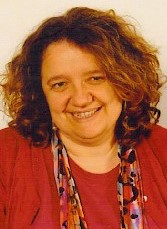
 So here is a photo of the splendid Carol Marples who made the wacky palms I so admired at the Edinburgh 2010 conference. I was oddly moved at the closing ceremony to see the head of one palm simply lying on the ground, blessing the pathway people took up to the Assembly room on the Mound. I immediately understood the allusion to Palm Sunday and thought, yes we are waiting for Christ to join us, we are ready to welcome him. Because Carol's palms are so colourful you couldn't really call them understated, yet the way they were used did not overplay the art itself - a gentle and deep gospel evocation came through, even if only passingly.
It's given me much food for thought and simply great pleasure and delight - it's pushed me to once more realise that I do not do enough art work and must get back to some soon - otherwise my soul will not be well marked.
Anyway you can find out more about Carol's work and workshop at Soul Marks, another good reason to go back to Edinburgh, there's a charity based there which uses the visual arts as tools for prayer, worship and community. It looks great fun.
You can also see more of Carol's work on the site of her church http://www.stjamesleith.org/index.htm
Sorry I didn't get to interview you Carol but maybe you'll make it to Geneva one day - or I'll make it back to Edinburgh.
Friday, 4 June 2010
Laying down stones which are younger than God
One of the things about the worship at Edinburgh 20110 I've particularly appreciated so far has been the blending of bagpipes and drums to call people to worship and to welcome people from around the world to the conference. It's been a great use of the external spaces and a wonderful way of blending cultures.
I've also appreciated the way that there has been sensitivity to language on the part of those leading worship and the way in which sermons have been allowed and talking and walking with the biblical themes has been encouraged. It's a blend of styles that may not work for everyone but which I've appreciated so far.
So yesterday morning stones which folk had brought from around the world were handed out to us and we held them and lay them down on the Celtic cross made out of cloth on the floor of the inside worship space. Blending the outside and inside spaces for teh worship has also worked well - mainly because the Scottish weather has been treating us with sunshine and mild weather.
Here's part of the opening liturgy, following bagpipes and the singing of Praise tot eh Lord the Almighty in four languages.
What I hold in my hand
is older than me ...
and older
What I hold in my hand is older than my name, my language, my culture ...
and older
It is as old a s the soil
as old as the sea ...
and older
It is as old as the earth
but younger than God
Thursday, 3 June 2010
Wacky palm fronds and powerful worship


Now some people might fear that this photo is part of my feminist plot to prove that the meeting here is overfilled with balding men but a) the Edinburgh 2010 meeting in more diverse than this picture shows b) your attention is supposed to be drawn to the totally wacky palm trees in the background - I'm hoping there will be some rather better photos of them on the Edinburgh 2010 site. I am not sure why but I really love these wacky cloth palm trees which looked blown by the wind. Standing up amongst them is the wonderful and equally colourful John Bell of the Iona community. This picture is from last night's welcoming songs and words, which was like the palm fronds a wonderfully joyful, colourful and tuneful time.
Scattered around the Pollock Halls conference venue the palm trees decorate special entrances and halls. But in colourful and yet discreet ways there are also coloured cloth leaves scattered in the gardens, often with the word peace, paz, pace embroidered on them.
Anyway I am already trying to work out if they will auction the palms off at the end of the meeting and whether I could carry one back on the eurostar. Wonder if I can convince a colleague to take the interpretation equipment for me so I can carry a wacky cloth palm home. More photos of them soon - they are lovely but somehow impossible to photo.
Tuesday, 25 May 2010
How to pray - eyes closed or eyes open?

 On the last evening of the Kirchentag a special service was held to launch a book which two of our friends Sabine Udodesku and Luca Negro have been closely involved in shepherding towards publication.
It's a wonderfrul resource of liturgical texts, each prayer is printed in six languages and an accompanying CD further languages too. It's a great idea, a very practical way of celebrating ecumenism and is one fruit of the 3rd European Ecumenical Assembly in Sibiu (where this blog was born!).
Called Laudate Omnes Gentes it includes some simple outlines for prayer services and about 40 liturgical songs to accompany the words in many languages. You can find out more here.
By the time the Saturday night of the Kirchentag arrived I was pretty tired so it was quite an experience to be one of about 4000 people gathered in one of the huge halls at the congress centre and to feel the sense of quiet and prayerfulness as we sang and prayed from our cardboard kirchentag "paphocke". I particularly enjoyed the opening Iona chant "come Holy spirit" which we sang in Geneva this morning and which I sense will become a new favourite of mine.
During the service several religious leaders were invited to share something about a favourite prayer. I particularly enjoyed Roman Catholic bishop Gerhard Feige speaking about the ecumenical experience of praying together in former East Germany. Margot Kässmann spoke last and chose Luther's morning and evening prayers, setting out how they offer a framework and the promise of God's angels watching over us whatever happens. By the time she had finished speaking I had tears on my cheeks, what she said came from the heart, was not over personal yet could speak to many.
This Sunday it was the words of Olav Fykse Tveit, our own general secretary, which came back to me. Standing behind the communion table with my colleague Bernard I realised I was praying the Lord's prayer with my eyes shut. Tveit had spoken simply and powerfully of how when he was a boy he had been encouraged to think that to pray properly you had to close your eyes. Getting more involved in ecumenism has led him to understand that he needed somehow to keep his eyes open to pray - even if only metaphorically - to see others, their need and suffering and to pray with them Christ's final prayer "that all may be one".
Since that tired Saturday night I've been thinking about the eyes open and eyes closed question where prayer is concerned
- do we really see others, their suffering, their joy, their concern?
- how do we hold this complex world in prayer before the God who created it?
Sometimes it is only by opening our eyes outwards that we truly see ourselves, only by closing our eyes that we are able to concentrate on the needs of others. Sometimes to see others, to pray for and with them, I need to physically close my eyes, yet the eye of the heart, the eye of prayer needs to be open.
More about Laudate omnes Gentes: Praying together- resources and songs for ecumenical celebrations here.
Photo: Nadine Malzkorn/2. ÖKT
Monday, 12 April 2010
The gospel - how ridiculous
In his sermon this morning Jooseup Keum said "how ridiculous" referring to Jesus washing his disciples feet. It really set me thinking about rationalitiy and spirituality, belief being foolishness to the Greeks and all that. It's too late for me to say much more for now, but it was a good start to the working week.
You can find Jooseup's thought-provoking sermon in full here but here are two extracts:
It was a lonely way. Jesus' way to the cross was a lonely way.
Nobody dared to walk together with him, even his disciples, maybe even us.
Imagine him, imagine his journey, he who is walking alone toward a cross. He carries all the agonies and sad stories of powerless people there. Somebody has lost their son, someone is crying, and someone is beating someone, someone is attempting suicide – can he provide any hope in their lives?
In the Gospel of John, Jesus is claiming the way is through washing the feet of his disciples. How ridiculous!
....
There are many ways in the world – motorway, bullet train and flight – however Jesus chose a tough, very lonely and slow way; off road. He is walking alone on a long endless mountainous path down to Galilee and waiting his disciples and us there. On his way to Galilee, he creates a new community of hope and love
Monday, 3 August 2009
The bread of life - a daily challenge and promise
My friend and colleague Theodore Gill preached on the "bread of life" this morning. It was a good sermon with much food for thought - so to say.
We had a large ecumenical group of visitors from Stuttgart in prayers this morning. Next year the Lutheran World Federation will hold its assembly in Stuttgart on the theme "Give us today our daily bread". Theo underlined how important the communal theme is - "our" daily bread not "my" daily bread. Like the manna that the Hebrew people gathered in the desert, bread is also highly perishable.
I managed to record Theo's sermon on my new gadget - now I just need to get all my different gadets speaking to one another and I might even be able to post it as a podcast - if I can remember how to access my box file. Ah the trials of blogging and the technical age! Perhaps Theo will just give me his notes ...
Meanwhile you can find this morning's liturgy here and a link to the splendid LWF cookbook "Food for Life".
Tuesday, 7 July 2009
Jan Hus and Jan Palach remembered as we celebrate truth not institutions
This morning we had an unusual treat for a Tuesday in the chapel. A very talented ecumenical Czech choir from Sumperk sang for the service and for invited members of the local Czech community and diplomatic corps. The service was led by Sarah Motley, an Anglican priest who has just finished the Masters in ecumenical studies at the Bossey Ecumenical Institute, and sisters who are part of the Bossey ecumenical spirituality project . Ms Belkys Teherán of the WSCF offered us a sung meditation on the reading from Romans 15. Belkys comes from Colombia which is one of the countries we are praying for through the ecumenical prayer cycle this week.
Towards the end of the service a Czech member of the congregation spoke briefly and passionately in memory of Jan Hus - many of the choir are from the Hussite Church - who was burnt at the stake on July 6th 1415. As he remembered Hus he said "we are here to celebrate truth not institutions" evoking also the memory of Jan Palach who chose to burn himself to death in 1969 to protest at the institution of Soviet communism and tanks following the crushed Prague Spring of 1968.
It was powerful to think that we were praying, singing and listening to celebrate truth ...
Friday, 10 April 2009
On a Friday Noon
 One of the things I miss about not leading worship myself on Good Friday is reading through the book On a Friday Noon from 1979 by Hans Ruedi Weber. I have copies in French and German and the texts are powerful reflections on suffering and the cross. Perhaps I shall try and make time to do that today in between rather more prosaic visits to the garden centre. You can get a glimpse of some of the contents here.
I was given my first copy in English by David and Mary Marsden for my 18th birthday, along with a copy of Dietrich Bonheoffer's letters and papers from prison. David was one of the ministers of the church I grew up in. He and Mary had a wide ecumenical and international experience, having lived in Singapore for more than a decade. David died in February this year, he preached at my ordination and I last saw him alive at my father's funeral.
Meanwhile Simon Barrow has been reflecting and writing about his father's death, Bonhoeffer, Maundy Thursday and his appreciation of high Anglican liturgy.
May prayer and reflection be part of your day today.

 Posts