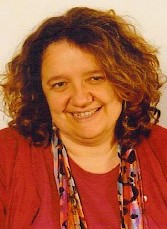
It's not every Sunday that you go to church and are welcomed by a photographer. This morning outside the Temple de Divonne, Jean-Jacques Bauswein took everyone's portrait photo before we went into church. And church was packed - by the time we got there - not quite late but very nearly - there were only seats left right at the every front! The service for Palm Sunday was prepared by the people who teach the young people and children. We were surrounded by the large posters of the EELF and ERF "à visage découvert" evangelisation campaign. Each of these is a picture of the face of a member of one of the Lutheran parishes in Paris together with the Bible verse they have chosen. The photos are also used on postcards and on a calendar. At the end of the service the wholoe congregation left the church in silence and went to the Alain Blancy parish hall to find printouts of our photos and to choose a Bible verse to put beneath our photos. Then we all stuck our photos on the large panel on the wall. Our choice of Bible text revealing a little bit more about ourselves than just our faces. I was impressed by how both adults and children managed to keep silent as we chose our verses and crowded around the tables in the parish room. You can find out more about the campaign here and here.
The Lutherans and the Reformed in France are on the way to becoming a united church in 2013. Although there are legal texts and votes that need to take place, the essence of the union is to bear witness to Jesus Christ today. This creative campaign is part of that. What is great about it is that it builds confidence and offers people reticent about talking about faith simple ways of affirming what is important for them. I'm proud of my church.
Sunday, 17 April 2011
Palm Sunday service on "ecoute Dieu nous parle"
Thursday, 20 January 2011
Moving Christian unity ...
Last night the local churches in Geneva organized the annual Week of Prayer for Christian Unity service. It took place in the chapel of the Ecumenical Centre this year, there were far more people than in the previous few years so we felt it was successful - and for the most part it was. We began with moving words from Father Megally the priest of Geneva's Coptic Orthodox Church, who thanked the local churches for their solidarity and prayers following the recent tragic attack on the Coptic Church in Alexandria.
The focus of the prayers this year is Jerusalem, the churches there prepared the material for the octave of prayer which is marked by Christians throughout the world. We had Middle Eastern as well as French music at last night's service.
The WCC's general secretary picked up on the theme of Jerusalem and of the table in his sermon
"The table is also a place and space that demands that we think about justice and the way food and access to power are shared in the world, especially at a time when speculation with food prices will mean that the poorest will become poorer, and go hungry."
"Perhaps the image of the table can help us with this, it is around the table that not only bread is broken but that the word is shared; the table is a place of fellowship, of joy, a place for learning and forging reconciliation. The table is also a place and space that demands that we think about justice and the way food and access to power are shared in the world, especially at a time when speculation with food prices will mean that the poorest will become poorer, and go hungry. Of course there is still sadly one table where we as Christians do not yet eat together. We live with the painful reality of our own divisions."
So last night, all went well, people were happy, the chapel was full, more than 30 different confessions were represented including several of the migration churches ... and yet as I look back on it I think that somehow we need to become more missional in our approach to Christian unity. I made a joke about how next year in order to change the age profile of those attending we should do a skateboard service for unity. I think of a friend who is a trained youth pastor and who is finding it hard to find a parish to go to as there are so few young people in the church. So I wonder will we dare next year to invite the church youth movements in Geneva to lead the service and do things a bit differently. It is difficult after something has seemingly worked and been a success to think like this. I'm concerned that we think we have found the formula for something that has worked and that we don't see what isn't working as a result.
So I suppose what I am saying is - things went well and that is good and to be celebrated, but a big challenge remains.
Saturday, 4 December 2010
Holding hands in a warm grasp whatever the weather
 Over the past year I have been on a steep learning curve about Norway, a country I have only visited once - though I did rather like it and celebrated my 40th birthday there under the midnight sun!
In one article I read some months ago about the Tromso outdoor winter film festival I came across the phrase "In Norway there is no such thing as bad weather just bad clothing".
I thought of this today as the World Council of Churches general secretary Olav Fykse Tveit, who is Norwegian, attended his first private audience with Pope Benedict XVI. Tveit and other colleagues at the WCC thought carefully about gifts for the Holy Father, in the end taking an inlaid wooden box from Syria as a reminder of deep concern for and solidarity with the people and Christian communities of the Middle East. Inside the box were some more personal gifts, a book of poetry by Olav H. Hauge which contains in Norwegian and English one of Tveit's favourite poems by Hauge "The Dream we Carry".
Rather more unusually one of the other gifts was a pair of Norwegian woollen gloves. Since coming into office at the WCC Tveit has tried to rehabilitate the meaning of winter, as a time for reflection and preparation. Communicators sometimes find this a bit difficult to deal with as there is also much talk of ecumenical winter. Tveit's clear message with the gloves was that however cold the actual or ecumenical weather there are always ways in which we can reach out to each other, support one another and walk hand in hand to carry forwards the work of unity and being one together.
I like the idea of this ecumenical reaching out to one another whatever the weather, a warm grasp across the divisions, inspired by epigramatic poetry: carrying the dream ... To advance Christian unity perhaps we all need to think not about how bad the weather is but how we can metaphorically clothe ourselves in such a away that we can still reach out in warmth to one another.
The photo is from the Osservatore Romano who have a further piece about the visit here.
And here's a link to the transcript of Vatican radio's interview with Tveit, in German.
Saturday, 2 October 2010
Rowan Williams on perceiving and living unity
 One of the reasons I buy books is that then I am allowed to scribble in them and go back to my scribblings.
At the end of Rowan Williams Silence and Honey Cakes there is a section of questiosn and answers that he took from the original audience for the lectures, The World Community for Christian Meditation. What follows below is part of his response to a question on "Can the institutional church teach the contemplative path?" Reading it I was reminded of some of the reflections by both Cardinal Walter Kasper and Bishop Kalistos Ware on spiritual ecumenism and an ecumenism of spirituality which we were privileged to listen to when they came to the ecumenical centre a few years ago.
Anyway the insights Williams offers here are a challenge for anyone working for the church as institution but then they come from someone who very much also works for the church as institution. Some more from the same question and answer session about the challenges of that role as Williams sees them in a later post.
"Nearly all Christians have inherited a functional idea of what the local Christian community is for: it gathers us for sacramental worship (with the sacraments seen rather as routine duties). But i think we need to break free a bit, recognizing that, in addition to the sacraments we meet for other kinds of togetherness, in study and prayer - which means challenging any model based on Sunday patterns alone.
Another thing harder to express, is that those of us who have the function to do so need to go on asking where the unity of the church lies and in what that unity consists. I believe it is a unity which exists fundamentally in a shared gazing towards Christ and through Christ looking into the mystery of the Father (which is what the sacraments celebrate and make possible). If we believe our unity comes from that looking together into a mystery, occasionally nudging each other to say, "look at that!", we can perhaps recognise that the unity we enjoy is not first and foremost an institutional matter; it is the common direction in which we strive to look. Of course we must be willing to nudge each other, as I put it, and tell each other what we're seeing. I think if we began with something a bit more like that, we'd see more space in the church for the contemplative dimension. If there aren't enough people looking into the mystery, unity comes to be seen in functional terms - meeting for events, discharging our obligations - and we miss the vital and living element of unity." p.110
Tuesday, 15 June 2010
The generosity of tweeting and does this change the way I see the people of God?
 So for the next few days I shall be tweeting here
http://twitter.com/Reformedcomunio.
Since the cecassembly in Lyon last year I seem to have got into tweeting as a conference event, it's quite a fun way to leave some trace of what is going on at business and discussion meetings and make it more immediate.
As a general rule to know what I am up to, you should follow the problems of travelling with one of my husband's socks by becoming my friend on facebook (I can quite understand why you might want to avoid doing this!) If you're interested in what is going on in my professional life then you can try to read between the lines at http://twitter.com/Oikoumene
As a result of all of this my own personal twitter feed has become very neglected but I suppose I sense that it is just lying there in wait for me to take it up again at some point and it does get fed by an RSS feed from my blog here.
Setting up the twitter feed for the new Reformed Communion today I thought about what an extraoridnarily generous medium twitter is. People follow you and so you follow them. Trawling through potential people to follow I realised that one of the things about social networking like this is that you don't just want to follow "people like yourself". Of course any organisation such as the WCRC has a very diverse identity anyway so it's important to be generous with your friendship and followers, it pushes against the "holy huddle" idea of what church and being a follower of Jesus is all about.
Spending some time in the diversity of the Reformed family as opposed to the wider ecumenical family makes me realise how fuzzy the boundaries and limits between our supposed denominations and tradtions often are. More evangelical and Pentecostal ways of celebrating worship are influencing liberal and traditional churches, we are learning to live together, to be one in ways I would not have believed possible even of myself 25 years ago. Perhaps to "be one" generosity towards the other is a key virtue to practise. Generosity changes the giver and the receiver, it's a gift of the spirit. Now I suppose I'd better go and tweet that - but on which channel?
Friday, 11 June 2010
Stop exhausting the earth - do summer differently
 As the northern hemisphere prepares for summer and holiday time the French Protestant Federation has launched a "give the earth a holiday campaign". You can read more about it here.
This is the 10th campaign seeking to raise awareness of environmental and care for creation issues within the FPF member churches.
The campaign is taking palce with the "live differently" collective
Monday, 25 January 2010
What kind of migrant are you?
At this morning's service in the chapel we closed the week of prayer for Christian unity with a reflection and celebration on hospitality. This was also a way to mark the beginning of the Churches Commission for Migrants in Europe year of the churches in solidarity with migrants.
Roswitha Golder, a minister of the Protestant Church in Geneva who worked for over 12 years with the Latin American Methodist community in the city, preached and interpreted the testimony of a member of her community. We sang and prayed and reflected on the meaning of hospitality. Ortensia, from Bolivia, spoke about how she was grateful for the opportunity to become a migrant worker as it meant she had been able to pay for the higher education of her children - her son had now qualified as an engineer. It was a moving tesitmony as she talked about how her own qualifications as a medical secretary were not transferable to Switzerland but that she was nevertheless grateful for the opportunities to provide for her family that working in Geneva provided.
Later when he was opening the exhibition made by the different migrant churches congregations, our new general secretary Olav Fykse Tveit spoke about how stories of migration spoke to almost all of us present. In Geneva in particular, many of us are migrants, but some of are much more privileged migrants than others. Issues of justice and migration have to be taken up by teh churches. Barbara Robra, who worked with the different churches from the "Witnessing together" network on the artistic project behind the exhibtion, spoke of the vibrancy and life in the congregations and the creativity that shone through, both in the panels that had been made but also in the quilting projects that had been part of the exhibition.
Thinking back to Ortensia's testimony I began to think about what kind of migrant I am. It is so easy for workers in international organisations to not think about themselves as migrant workers, to not recognise the privilege we have to be where we are, doing what we do. Do I think I am entitled to everything that comes my way because I'm an international worker? Am I a grateful migrant worker, do I give thanks to God like Ortensia was able to do so movingly this morning? Probably not in quite the same sort of way ... I speak about my faith and life in different ways. Yet the simpliciity of her gratitude spoke volumes to me of how important giving thanks is. It also brought some of my cynicism into sharp relief and called me to conversion: "Do justice, love kindness, walk humbly with your God".
Am I really able to be a hospitable privileged migrant worker, or do I just pray but not practise what I preach?
Praying this week for Denmark, Finland, Iceland, Norway and Sweden
Today is the final day in the octave of the week of prayer for Christian Unity. This morning the ecumenical centre will host a service led by people from Geneva's migrant churches and the "witnessing together" network. An exhibition prepared by each of the different congregations in the network will be on display in the entrance lobby at the Ecumenical Centre this week.
Meanwhile we are praying this week for countries in Scandinavia through the ecumenical prayer cycle. Countries thought of as rich and stable ... then you remember the Icelandic banking crisis and you know there is much to learn.
Later this week the World Economic Forum begins here in Switzerland, in Davos. The new WCC general secretary, who is from Norway, will attend part of it.
The week of prayer for Christian unity ends with much pointing us to reflect deeply on the spirit of unity needed in our solidarity, aid efforts, development work and particularly in terms of economic justice. Unity is not only about different families of Christianity learning to respect and understand each other, it is also about the whole of humanity working for the good of all.
We share a common earth.
We share the common joy of living,
of the grieving and of the pain.
We share the wonder of the sowing
and the harvest of our common soil.
We share the common bread in our homes.
We share the feast of the wine.
We share our common faith in Christ, our Saviour.
But we still cannot share the common table in our churches.
Why, God, why?
God of unity, let the table of reconciliation
become the true table of unity for the sake of your kingdom.
(c) Per Harling
Sunday, 24 January 2010
A resurrection story from the supermarket ...
Dr B needs bananas to get his potassium levels up so I called in on the supermarket, on my way back from the hospital. I didn't expect it to be a place where I witnessed resurrection.
At first I hardly recognised the man in front of me at the checkout but I noticed that his eyes were not bloodshot and his hands clean.Then I looked at what he was buying and compared it with what he had been buying 7 and 8 years ago. In those days he was grief-stricken, his beautiful brilliant partner died in an instant from a brain hemorrhage. For the funeral he had drunk heavily, her high-class parents from the other side of the world had found it hard to say much to him. They blamed him for being alive when she was dead, but politeness forbade them from ever having to do something so common as actually say that. They were tearlessly grief stricken.
His shopping in those months and years afterwards was always made up of baguette and large quantities of alcohol, and only that. I would see him regularly at the supermarket and try to offer to listen. Once even drinking a beer in the local bar with him, he more or less ran away. The pain too great. The drinking and drugs had begun before his lover the beautiful physicist had died. I remember her name and the Bible text I preached on and the sad tension of the funeral.
I had not seen him for a long time and certainly did not expect to witness the resurrection so clearly in the contents of his shopping, good food for two adults and a baby, no alcohol. He kept the queue waiting because he'd forgotten to weigh the broccoli. Instead of being irritated I just smiled and as he left wished him "bon weekend". He recognised my voice, turned round, saw he did know me, smiled and simply said "je vais bien" - I'm well - and went on his way.
All this week Christians in many parts of the world have been reflecting on the Emmaus story for the Week of Prayer for Christian Unity and in particular on the call "you are witnesses of these things". The Emmaus story recalls how it was in the breaking of the bread that the disicples witessed the resurrection and the scales fell from their eyes. On my Saturday night shop it was in the weighing of the broccoli that I witnessed resurrection.
Wednesday, 20 January 2010
All prayed out?
There were times when I was in pastoral ministry when I felt that I only really prayed when I prayed aloud to lead others in prayer. It was as if prayer only held that deeper feeling for me when leading worship. I used to worry about that, rightly so too I think. It is easy for pastors to get so used to leading worship that they never allow themselves time to receive, to pray in an ordinary way.
Today I have been praying in public rather alot - two big services in one late afternoon and evening. Our friend Karin Achtelstetter was ordained to the Word and Sacrament of the Evangelical Lutheran Church of Bavaria and it was a real privilege to lead the service with her bishop Ark Nitsche. Sometimes worship just works and this did, in a great mix of French, German and English with some touches of Portuguese and totally amazing music led by Terry Macarthur.
Then I went on to lead the local francophone Week of Prayer for Christian Unity combined service, which also featured stunning music, a good sermon by Christine Housel from WSCF and a liturgy that simply seemed to flow. It is a particular blessing when worship does the job of grounding heaven on earth and lifting earth more heavenwards in gentle, non-glitzy, real sorts of ways.
I was physically exhausted and so grateful a friend drove me home afterwards, but I didn't feel all prayed out, I sort of felt all prayed up: filled with something unnamed and beautiful - the Spirit perhaps ...
Given how the night turned out this was just as well ...
Tuesday, 19 January 2010
Coming home late on the Emmaus road

I came home late to find that one of the copies of Rowan Williams Headwaters had been delivered. It's a wonderfully exciting book, as poetry so often is - calming and speaking to the mind and spirit in new and unexpected ways. Somehow it is simply "pleasing" and yet much more than that too - perhaps exhilarating is more the word.
As this year's week of prayer for Chrisitian Unity focuses on the Emmaus story I was very moved to read the Archbishop of Canterbury's poem inspired by that story:
"we cannot learn
the rhythm we are asked to walk,
and what we hear is not each other.
Between us is filled up, the silence
is filled up, "
The final line particularly moved me for no reason I can explain:
"and our released voices shine with water."
The Week of Prayer for Christian Unity
The churches in Scotland have prepared the material for this year's Week of Prayer for Christian Unity.
In Ferney the Roman Catholic Bishop Monseigneur Bagnard will preach at the Protestant Temple on Sunday at 17.00. In Geneva the local council of churches is organizing a midweek prayer service on Wednesday at Emmanuel Church. All week members of the spirituality and faith and order teams within the WCC are leading our morning prayers.
I've been doing alot of thinking about unity, about ecumenism, about diversity, plurality, oneness and much more recently. But this week is - as my colleague John Gibaut so eloquently put it in a sermon - the week to pray for unity, not to write studies about it but to trust to one's own intuition and God's grace and pray "that they may all be one".
Monday, 18 January 2010
Intuition, epiphany and Emmaus to begin the week of prayer for Christian Unity
John's own intuition also pointed us to how intuition and blocked intuition works in the wonderful chapter 24 of Luke's gospel, the story of Emmaus. It is only as the bread is broken that the scales fall from the eyes of the disciples, as they begin to see who it was with them on the road to Emmaus and remember how their hearts had been warm and alive as he spoke to them, so intuition grants them the insight that this is indeed their risen Lord and as that deep understanding comes he is no longer to be physically seen.
Here are a couple of extracts from the sermon which I will post in full once he's written in the joke - or link to on the WCC site if it gets posted there:
These “epiphany” moments or flashes of intuition characterise so much of the encounters between God and humanity in the Bible. The recognition of God’s self-revelation is so often the experience of deep intuition.
Like laughter, the news of the resurrection is infectious, and spreads, and is shared as the Risen Christ continues to be there where two or three are gathered in his name however unrecognisable, and we caught off guard by the unexpected, and know intuitively that the Lord is risen indeed!
Saturday, 5 December 2009
Christian history at KT - confessions, divisions ... and chance of unity?
I've spent part of today teaching KT. It's always good for me, helps me centre on people outside myself. Compared with the UK there is very little teaching about religion or the differences between religions at state schools in France. So we decided that with the vote about the minarets in Switzerland last weekend, and the interest that the young people had shown at the beginning of the year in learning about other religions we would try to do some of that today.
We began with Christianity before going on to look at Judaism and Islam.
In everyday French it's fairly difficult to trace the fairly key nuance between a different confession and a different religion. I was shocked at my first Week of Prayer for Christian Unity meetings in France to have people from the Catholic Church come up to me and say "we must do more inter-religious dialogue like this".
Today we started by looking at the different Christian confessions and by tracing where each of the many branches of Protestantism came from and then going back to what had preceded the Reformation and the great schism of 1054.
So we moved from the complex diversity of Christianity to looking briefly at Judaism and Islam. I was impressed by how genuinely the coung people voiced their concern that all people should be allowed to worship as they see fit. There is also an enormous ignorance of what the beliefs and practices of other religions are and part of me felt that we should try in local churches to offer an opportunity to discover other religions - not just for young people but for their parents and grandparents.
After lunch we did some remembered Bible of Christ's nativity with them. Fascinating to remember the story and then to read first Matthew and then Luke. I was struck by the different kind of Messiah each evangelist seemed to be expecting - in Matthew the baby is portrayed as the equal of kings and great Eastern intelectuals; in Luke this birth brings hope to excluded shepherds on the hillside. The beginnings of Christian diversity are right there in the way the gospels each tell their story of Christ. Christian unity and reconciled diversity are perhaps only possible if we dare - across our confessional differences - to go on telling our own and Christ's story to one another.
Sunday, 28 December 2008
Schleiermacher and Christmas
 You can tell you are in Germany when you open your daily newspaper over breakfast (OK, it was the Frankfurter Allgemeine Zeitung - or FAZ ) on Christmas Eve and there is a whole page given over to "Bildungswelten"- in this case to an essay by theologian Eberhard Jüngel, on "Christmas Eve" by the 18th-19th century theologian Friedrich Daniel Schleiermacher. Written in the style of a platonic dialogue, the work is set in a bourgeois household on Christmas eve where the protagonists discuss the meaning of the incarnation. First published in 1806, the Christmas Eve story has become Schleiermacher's most republished work, born in 1768 as the son of a Reformed pastor, and educated by the Moravian Brethren (or Herrnhuter) from whom comes the Moravian Star that you see all over Berlin at Christmas time. With time, Schleiermacher grew away from the pietism of the Moravians, and after a time in Halle, spent the last 24 years of his life as a professor at the newly founded Friedrich Wilhelm university in Berlin (rebaptised the Humboldt University after the Second World War). He was also an ecumenist before his time, being an enthusiastic supporter of the union of Reformed and Lutheran churches proclaimed by the the king in 1817. He even wrote a - never enacted - constitution for the Reformed-Lutheran union - and, the FAZ tells us, his academic work suffered in the 1820s because of his involvement to the cause of church union.
In fact, just round the corner from where we are staying in Berlin is the new home of the Humboldt University's Theological Faculty (a far cry from the wooden "shed" near Friedrichstrasse in which the theology section was housed when Dr B studied there 25 years ago). The ground floor lobby of the theological faculty has this saying of Schleiermacher: "Soll der Knoten der Geschichte so auseinander gehen: Das Christentum mit der Barbarei, und die Wissenschaft mit dem Unglauben?" - Shall the knot of history unravel in such a way that Christianity is identified with barbarism and modern knowledge with unbelief?
Wednesday, 5 March 2008
"Discerning the Body" - reflections by Theodore Gill
I've just posted a reflection by my colleague Theo Gill from morning prayer today. I was still stuck in Geneva motor show traffic when prayers took place today (no doubt I will rant about that at some later date on my blog!). Fortunately, and unlike me, Theo writes what he is going to say so we can all share at least in the written word, though we unfortunately miss on his powerful delivery. I really must start recording chapel so we can have some podcasts - however, I do have a day job to consider so perhaps I am already getting too ambitious. It might be quite fun though.
Anyway Theo gave a passionate defence of and plea for unity around the one table - a plea to discern the body.
"Reading the letters of Paul, anachronistically speaking, is often like listening to one side of a telephone conversation. One has to imagine what is being said at the other end of the line. There are moments in early passages of this epistle when we imagine that all is not well at the Corinthian church, but as we reach the section that we know as chapter 11 there is no longer room for doubt. Paul begins to berate the Christians of Corinth for their unabashed disunity, their lack of hospitality – much less charity, their gluttony and drunkenness at the table of the Lord and – most of all – their failure to “discern the body” there."
Friday, 25 January 2008
Praying for unity in Rome
Samuel Kobia, the WCC general secretary, attended vespers at St Paul's outside the walls in Rome this evening. Pope Benedict XVI presided and preached at the ecumenical service which marked the official close to the 100th anniversary of the week of prayer for Christian unity in the Italian capital.
In an interview with L'Osservatore Romano Kobia said "My vision for the ecumenical movement is that by the mid-21st century we will have reached a level of unity such that Christians everywhere regardless of their confessional affiliations, can pray and worship together and feel welcome to share in the Lord's Table at every church." You can read more in ENI here and on the WCC site here. Reuters have also written about the interview.
Tuesday, 22 January 2008
Praying for unity - is it about justice or about prayer?

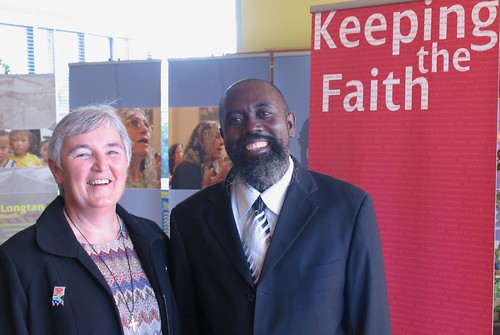
Sister Sheila Flynn spoke movingly on Sunday of unity not being possible if the unity we pray for remains indifferent to the millions living with and dying of HIV/AIDS. The women she works with at Kopanang sent her with a message to Geneva - tell them not to forget us. (The picture, like the others in this post is by my colleague Juan Michel and shows Pierre and Sheila at the WCC). Rev. Jean-Claude Mokry preached about how the week of prayer's theme "pray without ceasing" served as a springboard to renew our personal, local and global witness, rooting prayer in practical experience and expression.
Thursday, 17 January 2008
Art for humanity -linking fine art and humanrights advocacy
On Friday morning as the launch of the Week of Prayer for Christian Unity in Geneva sister Sheila Flynn will lead morning prayers. Sister Sheila is a Dominican and also has fine arts training. Among other things she is also involved in a non-profit organisation called Art for Humanity based in Durban, South Africa. It specialises in producing fine art print portfolios, exhibitions, billboards and research projects that advocate various human rights issues in South Africa and internationally. You can see Sheila Flynn's very powerful lullaby of the left behind and much other wonderful stuff. The website serves as an online resource for those interested in human rights, art and social development. It's a brilliant idea and resource.
Thursday, 10 January 2008
The Week of Prayer for Christian Unity on Facebook
I learnt that my colleagues Natalie Maxson and Roger Schmidt, together with others from the WSCF and World YWCA and YMCA, have not only called for more youth involvement in the week of prayer for Christian unity, but they're also using facebook to encourage young people to get more involved in doing things during the week of prayer for Christian unity. They've got quite a number of young people signing up and are encouraging them to meet with other Christians for Bible study, prayer, social action or worship during the week of prayer and then to share experiences and ideas on facebook.
As for me, I'm still paddling in the shallows where facebook is concerned, at least it will give me something to talk about with the young people at KT tomorrow.

 Posts
Posts