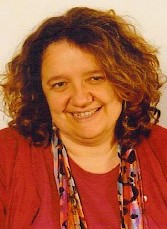
Over the next three days here in Dresden people are hanging the bright green Kirchentag scarves around their necks and setting off to huge and much smaller events throguhout the city. It seems busier than ever at this Kirchentag and it's not just an impression. Today's press conference confirmed that there are more participants at this Kirchentag than at Bremen, Cologne or Hannover. Over 117,000 people have bought three day tickets and there are over 6,800 foreign visitors.Some are even saying that this is truly the first Kirchentag for the whole of Germany, for a united Germany.
Tonight Dresden has more than 250, 000 people in the streets for the evening of encounters. The atmosphere is great even if the weather is a little cool, at least it isn't raining though. I wonder whether it is the city itself which also attracts people, many have come on a cycling pilgrimage to get here. Set on the Elbe and as a symbol of post war reconciliation, it's a beautiful but also a very meaningful place.
Dreasden also refers to itself as being in heart of Europe. The Czech and Polish borders are not far away at all. So this Kirchentag is trying to particularly open up contacts with the churches and academies in central and eastern Europe. There's a great programme at the Three Kings Church organised jointly by the Prague ecumenical academy and Dresden's church house. It's wonderful to walk the streets and be in the hotel lobby and hear Czech, Hungarian and Polish being spoken. and tonight the city centre is pulsing first to the sound of the different opening services and now to concerts. Later tonight there will be an open air performance of a specially commissioned piece of music based on the Kirchentag theme and thousands of candles will be lit.
One of the other moving things about being in Dresden is seeing the memorials in the streets to the peaceful revolution in 1989.
The WCC general secretary has also spoken today of how churches in Dresden promoted reconciliation between former enemies after the Second World War. They also supported peace and justice groups during the time of communist rule and in doing so had helped advance the peaceful revolution of 1989 which brought down the Berlin Wall and eventually united East and West Germany.
Being here also reminds me that the East of Europe is important to me. It's good to be back. This may be my last Kirchentag for a while so it's good to be in what I like to think of as "my" part of Germany. Really pleased too that it is already such a success.
Wednesday, 1 June 2011
A heart for the Kirchentag in the East
Saturday, 4 December 2010
We have become a published author!
 On Monday evening there were strange scenes in our household as champagne was drunk despite it being the beginning of the week. At last we received a copy of Stephen's book! The publisher's had tried to send one last week but a different - also quite interesting book - arrived instead. We knew it was at last published because a Facebook friend told us her copy had arrived!
Anyway, it is cause for much rejoicing. The foreword has been written by Dr Margot Kässmann and Dr B has benefitted from a veritable harem of German proof readers. Thanks to all of them.
He is trying to say that he will be doing an English version soon, but I think I may need a holiday before that!
Anyway Amazon.de claim to have already sold out of copies but maybe they'll stock up soon, so to buy Dr B's book for now you can go to the book depository here.
Friday, 3 September 2010
When events you have lived through become walks of history

At one time I had intended to call my GDR memoir "Herr Modrow walks home" Hans Modrow was leader of the SED in Dresden at the end of the GDR. Many attribute the fact that early in October things took a peaceful turn in Dresden to his leadership at the time - he was in the end the premier of the GDR when the first free elections took place.
Today coming out of the Hauptbahnhof I was confronted by the Wege in die Freiheit street installation. I remember those days in early October 1989 so well ... then less than a year later on 3 October 1990 Germany was united. Who has even heard of or remembers Hans Modrow now? A trivial pursuit question in a very specialised history section.
Walking through the streets of Dresden and finding my way to the Ibis hotel where the Kirchentag is putting us up and realising it is the same hotel we stayed in when we started our honeymoon here in Dresden is quite an odd trip down memory lane. It looks the same but it doesn't at all feel the same ...
everything has been so repackaged and events are such a long time in the past already.
My heart loves this part of Germany. Coming to Dresden has shown me how much this is part of me and I am still part of this history - not just from 20 years ago but from further back still. My German grandmother came from further east still, Breslau, now Wroclaw. The streets here speak to me, even without the history installation, but perhaps without that visual reminder I wouldn't have begun to listen to the streets talking.
Of course I never did write a memoir - maybe I'll have to change that and finally type up my diaries for the 25th anniversary.
Friday, 30 April 2010
Fallen walls of shame are symbols of hope


Dr B took these and other photos at a short ceremony at the end of the day around the two large pieces of the Berlin wall which are in the garden of the Ecumenical Centre. In the public park of Grand Saconnex a special sign was put up today to point the way to these pieces of the wall in the ecumenical garden. At the same time another sign was erected pointing in the opposite direction to a boat shaped commemoration by the Vietnamese community who were received by the commune of Grand Saconnex in the 1970s after fleeing across the seas.
The local Swiss authorities all turned up dressed in full regalia, I always find this rather wonderful and it made us smile to watch them walking through the car park and up to the pieces of the Berlin wall. It seemed right and Swiss and a good honouring of local democracy and civil society.
The WCC general secretary Olav Fykse Tveit welcomed the local authorities saying:
I'm old enough to have seen this wall in its former place in Berlin. One of the worst experiences of my life. It was a sign of what humanity should not be and should not do, to separate those who belong together.He then handed over to Jean Fischer who is a former general secretary of the Conference of European Churches and was in the at role when the wall was given to CEC. It's always interesting to compare what we thought we knew about the pieces of the wall with what Jean told us in his speech
I am grateful this wall is now in pieces and these pieces are signs of hope and of the future. They are signs that it is possible to make a difference.
We have a "prophetic role" to tear down what should be torn down and to "have a vision" This is our calling from God. To bring together what belongs together, to be one.
Jean ended by calling for walls of shame around the world to be brought down - from Mexico to Israel, from Belfast to Cyprus - both the physical walls of shame and the shameful walls of racism, exclusion and poverty.
I made a request to have two pieces of the wall the when in Berlin the week after the wall came down. Heard nothing for months and then got a telephone call from a colonel in the German army who said, your two pieces of the wall are here, please send a lorry to pick them up.
The wall was put up in 1961 but fell in several hours. The wall of shame and the Iron Curtain was destroyed. CEC had since WW2 tries to keep links between the free world and the Soviet ruled world.
There are new walls in Cyprus, in Ireland. A report in Le Monde from Belfast recounts how more and more walls are being put up to keep the communities apart. Never has the city been so calm, never has it been more divided. More and more people say "High walls make good neighbours".
More photos here.

Thursday, 11 March 2010
20 years ago in the GDR
Dr B has begun to post again both on Holy Disorder (another extract from my diary but also this on a day of anniversaries) and on Open source ecumenism.
What is interesting is that although the fall of the wall took place in November 1989 the real changes were all in 1990. 20 years ago the GDR was preparing for its first free elections and it was clear to me that the CDU would win. On the other side of the world in Seoul, Korea, Stephen was telling Heino Falcke my evaluation of the political situation in the GDR and he really didn't want to believe it.
Saturday, 13 February 2010
The 65th anniversary of the bombing of Dresden - how do we write history?
 Over on Holy Disorder Dr B has written a post about the 65th anniversary of the bombing of Dresden, a sign perhaps that he is beginning to get better.
This morning on the radio there was an interview with someone from bomber command trying to claim the moral highground for the bombers - he deplored that there was no memorial to the bomber pilots in Britain whereas we had a memorial to women's contribution to the war.
His derision of the role of women in the British war effort irritated me no end as you can imagine, but it is also interesting that we think that the "real work" of war is more about bombing civilians, destroying cities, churches and galleries than ploughing fields, typing papers, caring for children making sure food is prepared. Decrying as insignificant the supposedly "soft" role that women performed is also an ignorant approach, given historical studies that put forward the idea that one of the things that may have finally held Germany back in the second world war was the persistent refusal of the Third Reich to involve women in the labour force.
However, leaving my feminist rant to one side, what shocks me about the debate in Britain on "Bomber Harris" and on the whole bombing policy of Germany, is the way that those who continue to question the policy of bombing were called "revisionists" by the person interviewed on the radio this morning and this went unchallenged. In terms of the Second World War the "revisionists" are those who claim that the Holocaust didn't happen, putting those who question Allied bombing policies in the same camp is really not on. I am very concerned also at the ideological approach to history. This was war, it was not all good or right, wrong decisions were taken. Any memorial to those who did the "heroic" bombing surely needs to be held together with a memorial to those non-heroic victims in Dresden, Coventry, London, Hamburg, Berlin and elsewhere who lost their lives to those heroic bombs and the ensuing destruction. Memorials errected only to the supposed heros do not tell us the whole story of the horror and futility of war for ordinary people.
When I first read Stephen's post about Dresden this morning I actually thought about Rolf Hochhuth's book A German Love Story - Eine Liebe in Deutschland. It's years since I read it and as with many of my favourite books it seems to have disappeared from my shelves, must have lent it to someone. The book charts a love story between a Polish prisoner of war and a German woman in Brombach, it is based on fact and on Hochhuth's interviews with people and also has fascinating wider picture excerpt from Churchill's war rooms as he plans for the bombing of german cities. It is a hard read - the reader struggles with the story, the reportage and the history, feeling buffetted by the different prose forms and time lines. It holds together the atrocities of war, the personal tragedy of war and leaves the reader with more questions than answers. Hochhuth is best known for his polemical play The Deputy, Der Stellvertreter, which charts Kurt Gerstein's story. Until I started writing this I did not know that his play "Soldiers" which implicated Churchill in bombing of civilian targets was initially banned in Britain.
Wednesday, 2 December 2009
In mourning for the creator of the Ampelmann
 Our household is sad to hear that Karl Peglau designer of the wonderful East German Ampelmann has died.
You can read more about the context of the Ampelmann on Holy Disorder here.
If you have a photo of a green or red sign for crossing or not crossing the road we would love to see it, send me the link. We have a great poster of red and green persons from around the worldin our downstairs toilet . On special days when crossing the road Dr B will cross the road while trying to make the shape indicated by whichever green man appears.
Bizarrely in centralised France there is no unified "Euroman" - or europerson - but a plethora of quite strange red and green personnages at pedestrian crossings, including some very 1950s looking gentlemen wearing hats.
Twenty years ago today Gorbachev visited the Vatican
More from my GDR diary. I had completely forgotten that this happened until listening to the radio last night. Then I discover I had mentioned it in my diary 20 years ago. Now I just have to ask Dr B to do some research and find out if anyone from the WCC attended the meeting.
Friday, 20 November 2009
Twenty years ago today I was crossing Checkpoint Charlie
Dr B and I were still the only couple separated by the fallen Berlin wall. You can read about it over on Holy Disorder.
Wednesday, 18 November 2009
An evening on the role of the churches in the GDR at the Eglise Réformée in Ferney Voltaire
On Friday evening this week Stephen and I will return to our former residence at 13 rue de Gex here in Ferney where Stephen will do a presentation/discussion on the role of the churches in the fall of the Berlin Wall and I will read some extracts from my diary - translated into French. Of course you can go on reading his reflections in English on Holy Disorder. But if you speak French and are in Ferney on Friday evening the Temple Protestant in just 5 minutes up the hill from Voltaire's statue.
Venez nous rejoindre!
Cette semaine, nous avons beaucoup entendu parler des événements du novembre 1989 en Allemagne. Mais que savons nous sur le rôle important qu'avaient joué les églises d'Allemagne d'Est avant cet changement?
Le journaliste Stephen Brown vivait en RDA dans les années 1983/1984 et en était témoin. Il a consacré ses recherches à cette influence et a obtenu son doctorat pour ce travail. Stephen Brown nous présentera cette période d'histoire le vendredi 20 novembre à vingt heures au
presbytère de Ferney Voltaire.
Saturday, 14 November 2009
Passing thoughts about thorns, humility and leadership
I first heard the passage below being read aloud in the chapel in the Predigerseminar in 1989. In the midst of the huge political upheavalof the GDR's peaceful revolution, Gabriele who led that morning's "Andacht" simply let the text speak for itself.
I was surprised and pleased to find it again the other day at the beginning to Stephen Cottrell's splendid little book "Hit the Ground Kneeling". I'm not sure I've come across it in any of our Sunday lectionaries, which is a shame. I have used it in some youth work and training sessions with elders though.
Reading it through again now I wonder about whether bramble or thorn bush would be my favoured translation and I must go and check whether the Hebrew word is the same as the bush which burned and was not consumed in Exodus and whether the Septuagint translation for thornbush is then picked up in the gospel term for crown of thorns. This is how linguists think I suppose - even when they have a bus to catch and must write fast!
None of the other trees wanted to give anything up in order to sway over the other trees - not the olive its oil, not the fig its sweet fruit, not the vine its glorious juice and wine. So the thorn bush, the bramble, accepts. The thornbush is an uncomfortable symbol of humility in the Bible, it is about a different kind of leadership. Today reading this text I was struck rather by the way the supposedly greater trees don't want to take up office, they want to hold onto their current roles and riches and place in the scheme of things and not chance the risk or humility of leadership. Them holding on to their power and riches and roles makes the leadership role of the brambly thorn bush yet more difficult. Easier to be a celebrity than a leader? Easier to hold on to riches than follow vocation?
A fascinating and powerful parable which is deeply prophetic.
The parable and prophecy of the trees in Judges 9
The trees once went out
to anoint a king over themselves.
So they said to the olive tree,
“Reign over us.”
The olive tree answered them,
“Shall I stop producing my rich oil
by which gods and mortals are honoured,
and go to sway over the trees?”
Then the trees said to the fig tree,
“You come and reign over us.”
But the fig tree answered them,
“Shall I stop producing my sweetness
and my delicious fruit,
and go to sway over the trees?”
Then the trees said to the vine,
“You come and reign over us.”
But the vine said to them,
“Shall I stop producing my wine
that cheers gods and mortals,
and go to sway over the trees?”
So all the trees said to the bramble,
“You come and reign over us.”
And the bramble said to the trees,
“If in good faith you are anointing me king over you,
then come and take refuge in my shade;
but if not, let fire come out of the bramble
and devour the cedars of Lebanon.”
Thursday, 12 November 2009
Into the promised land or into the desert?
As I think back to the end of the GDR 20 years ago a theme I return to is that of the promised land or the desert.
In large part this is because of an encounter with a lecture by Jürgen Ebach early in my time in Wittenberg. About a week before the GDR was due to celebrate its 40th anniversary in early October, Ebach was on a tour of some churches in the GDR, speaking in particular to ministers, theology students and church workers. He spoke passionately about developing a theology that takes failure seriously - sometimes those who fail are the greater heroes (I remember being rather surprised at the time that he mentioned Scott of the Antarctic in this respect - probably because I assumed it was a story not much known outside Britain). Moses who receives the promise of the promised land never actually gets to live there and only glimpses it from afar before death.
It is only now though that I realise how very carefully thought out Ebach's lectures were and also how deeply pastoral. It would not have occurred to him or to any of us that the Berlin wall would no longer be there 6 weeks later. So underpinning what he was saying was a deep commitment to using the biblical texts about the 40 years in the desert leading to the promised land as a resource for reflection and resistance for the context of the churches in the GDR - perhaps for the next forty years. Are you so sure that you have been in the desert for 40 years? Are you sure that you are not only now leaving Egypt?
I can see now that he was trying to encourage the leaders of the church in local situations to continue to dialogue with biblical texts and let them speak to their situations. In a way he was saying, your struggle is going to go on, how are you going to help the faithful wrestle with the fact that after 40 years there was no promised land - and although I have often thought about and returned to his lectures it is only now that I can sense this layer in the insights he was sharing.
So was the opening of the wall the promised land? I can remember being a bystander as people voted for the first time in March 1990 and then again twice more that same year - the enthusiasm already beginning to wane.
So I wonder ... if Jürgen Ebach revisited his lectures today what would he try to say to the tiny minority churches in the former GDR? Are we all in the promised land or are we in the desert? Is state communism more or less of a desert than social market economies? Is capitalism the only promised land available? Where is the wicked Pharaoh we are fleeing from - even though we also yearn to be back in those fleshpots of the past when faced with the rigors of desert living?
Meanwhile I can't help thinking how very clever the CDU was with its horrible election slogan of Wohlstand für Alle - it really tapped in to desires for the future and offered quite a greedy promise. Of course the biblical land of promise is not one where all have good incomes but rather one in which the basic necessities of all can potentially be met. A land in which there will be pasture enough for you to milk the sheep and pollen enough for you to harvest honey. God won't be raining the manna and quails down from heaven. It's actually the promise of a semi-nomadic lifestyle in a slightly less difficult environment rather than a completely nomadic existence in a mainly hostile environment! Trying to sell that in your political programme may be rather dififcult.
Wednesday, 11 November 2009
Lakritz, Latein und grosse Wäsche ...
It only cost 50 pfenning and was published by the Protestant publishing house in the GDR. Just 50 pages long and five short stories from five different authors.
The first is a love story by Siegfried Lenz and this is what I've been reading again this evening. It brings back lots of memories of being in the chapel in the cellar of the Predigerseminar in Wittenberg. That was where I first heard Lenz's love story told. It put a smile on our faces early in the morning and one of the line's in the story became a sort of code "Willst Lakritz?" - do you want liquorice - it was a way of trying to laugh at the crazy pointless necessity of studying theology in the middle of a revolution. Repeating that phrase also reminded us of the importance of story, of being touched by a narrative beyond our own - despite being caught up in that crazy political narrative. Remembering this little story helped us have a bit of control somehow - and it made us laugh.
What I love about this tiny pamphlet-like book is its lack of pretention but also its pure goodnaturedness, here are five really great short stories for reading aloud or reading alone. Enjoy. What a wonderful thing for a church publishing house to offer people living under communism - quite simply a good read, enjoyment, pleasure. Feed your mind and your imagination. Tell your story.
For me reading this story again also conjures up strong GDR cigarette smoke, the smell of the coffee grounds being brewed in the small kitchen outside my room and the image of us sprawled and talking in the corridor, telling stories, testing out our narratives.
The truth is that I have never much liked liquorice at all. However, narratives have a strange twist and part of my GDR story was about falling in love with the person I heard telling the Siegfried Lenz story. I was falling in love with someone while being in love with (and engaged to) another person who was a long way away. Most of that story was not written in my GDR diary but it forms part of the context and prism through which I look back to what it was like to live through a revolution. A time of heady personal emotions as well as of politics.
So what about you, willst Lakritz? Do you want some liquorice? What's your story?
Tuesday, 10 November 2009
Reading, writing, thinking, sleeping ... Berlin 20 year on
Dr B has gone to Berlin from Brussels without a map. He has been writing both on Holy Disorder and for work about the Berlin wall and has been quoted as a "historicus" in a Dutch newspaper which made me smile.
He may now be in Brussels without a map but he has been travelling from Geneva to Berlin to Brussels with my GDR diary, which he's also been typing into the blog. You can read my 10 November 1989 entry here and scroll around on Holy Disorder for some of the other entries. Later in the year a radio diary in German will be posted.
So what will we do when the 20th anniversary year is finally over on 3 October next year?
Monday, 9 November 2009
With candles and with great courage ...
Today at lunchtime we met at the pieces of the Berlin wall in the garden of the ecumenical centre for prayers. A visitor from outside the house asked "so which side was in the east and which in the west?" I explained that it would not have been possible to paint the eastern side with gaffitti. This led me to say during our prayers that we were lighting the candles on the wrong side - it was not Helmut Kohl who brought the wall down but people with candles and courage on the other side! Even though the sun had come out I also said that the weather reminded me of an Iona peace liturgy for a rainy day - choose a symbol that will work on a wet day - not a candle! The wind did manage to blow out alot of candles - and the rain managed to deal with the rest later in the day.
I shamelssly plagiarised what Stephen has been writing on Holy Disorder to put together the simple liturgy. Using also my own diary extracts from that extraordinary year in the GDR - that's where the idea for using Psalm 126 came from. I also remember Friedrich Schorlemmer at the end of a particularly difficult day simply saying to us in Wittenberg, let's close this session by singing the Luther peace hymn which is why I chose Verleih uns Frieden gnädiglich to end with. I can remember being very moved by its wonderful minor melodies and the fact that everyone apart from me knew the words.
I also love the footnote at the bottom of The love of God is broad like beach and meadow - saying that the GDR government was concerned that the words of the hymn were criticising the state using religious language! It was good to sing one of Fred Kaan's hymns in translation after listening to a tribute to him on the radio last night.
So for 20 minutes at lunchtime we celebrated the spirituality of civil society that changed the world. coming home this evening I have heard a story of women walking together today across the peace line in Northern Ireland and of people trying to remove the wall in Palestine ... it seems right to use this anniversary as a starting point to overcome the barriers and divisions of our own times.
Then our mouth was filled with laughter,
and our tongue with shouts of joy;
then it was said among the nations,
‘The Lord has done great things for them.’
The Lord has done great things for us,
and we rejoiced. (Ps. 126)
Breaking bread on the morning of the day the Berlin wall fell ...
On the morning of 9th November 1989 I was one of the twenty or so ministry students at the Predigerseminar in Wittenberg. We had 10 day modules allowing for a four day weekend beginning after lunch on the Thursday. The Thursday mornings were for our "Auswertungsrunde". Believe me you cannot really understand the groan that this even now inspires in me unless you have been through this kind of evaluation with German theologians who are all direct and critical of the methodologies and content of what and how they are learning ... it is quite indescribable. Of the 25 of us sitting around the evaluation table that morning four people were founding members of three of the different new political parties in the GDR, several had taken part in the big Berlin demonstration on October 7th, one of our lecturers had been a speaker at the huge demonstration in Berlin on November 4th. These were some of the biggish fish in the small GDR pond.
Everyone around the table knew someone who had been imprisoned, several had seen the violence first hand. Together we had begun the prayers for renewal in Wittenberg, experienced and led Reformation Day and Buss und Bettag, learned about liturgy and preaching.
We were young but adults, full of hope, getting ready to have that hope dashed, cynicism was there under the surface. During the previous week we had begun to receive reports of the police brutality towards thos imprisoned in Berlin and Halle at the beginning of October. We had read some of those reports out at our morning prayers and wept and raged. Our emotions were elemental, we were living through a revolution yet everyone was away from home and would rather have been at home with their own peace and church groups, going on the demonstrations with their friends and family - apart from me ...
I had suggested - ever the liturgist - that we should end each 10 day module with a communion service. So after two hours of telling each other what we thought of one another in no uncertain terms, we moved from the painful evaluation table not to the upper but to the lower room where a simple round table is set with bread and wine.
I clearly remember Friedrich Schorlemmer bringing flowers to the table at the last moment and my being deeply moved by that. In my memory they were pinkish snapdragons, but perhaps my memory fails me - surely they could not have survived so far into the season, that must have been on a previous occasion, one eucharist speaks of and reminds one of another. I remember the flowers though, from one of those eucharists and I remember Friedrich's face and body as he place this offering of beauty on the table. (Dr B has my diary and we will see whether my memory was wrong.)
I presided at our round table eucharist and I spoke of remembrance, of my Grandfather being arrested in the Kristallnacht raids and taken away to Sachsenhausen concentration camp 51 years earlier. And so with stories of brokenness, pain and hope all around us, having shared hard and gentler words with each other, we broke bread and drank wine in memory of the one who was broken and shed for us.
Next to me as we prayed and felt the bread and wine in our mouths, my friend U began to sob, tears rolling down his face. He is not ashamed of his grief and emotion. As I think back to that morning my hand remembers the feel of his jeans as I placed my hand on his leg in an attempt not to quiet him but simply to offer comfort and in some strange way to say yes this is what it has been like.
Twelve hours later U and many of the others were spending the night at the impromptu street party on both sides of the wall. The feast of memory became the party of liberation.
Sunday, 8 November 2009
Happy birthday Axel Noack!
 Axel Noack is 60 today, which means that 20 years ago, one month and a day after the GDR celebrated its 40th birthday and just a day before the Berlin wall came down he was celebrating his 40th birthday,
Axel and his wife Gisela were ministers in Wolfen until 1997 then he was elected bishop of Magedeburg. He very selflessly stood down from being bishop this summer so as to allow for just one bishop to be elected to the newly united Protestant Church in Central Germany - the bishop of Thuringen having already retired.
I arrived at the Noack's manse in Wolfen at the end of August 1989 after a conference in Erfurt and stayed there 10 days while waiting for my second GDR visa before beginning my studies in Wittenberg. The evening that I arrived the youth group came round for their home coming festivities following the recent cycling tour Axel had taken them on to Poland. Getting those visas had taken alot of negotiating in that difficult summer, as West German embassies throughout the Eastern Bloc were filling up with East Germans trying to leave for the West. It was not often that official foreign travel visas had the box for mode of transport filled with the word "bicycle". Years later when we visited Axel and Gisela in Magedeburg they came to fetch us at the railway station by bike.
They opened up their home to me during that extraordinary year that I was in the GDR. I often spent my free long weekends from Wittenberg with them and then I worked with them for six months and moved into the empty manse in Greppin, where Stephen later joined me. It would be difficult to say how much and what I learned from them. I saw the strains and stresses of daily life in the manse, saw how each of them integrated their spirituality into their ministry in very different ways, travelled with Axel to voter information evenings and sessions on East German Church history, cycled with Gisela to visit some of the Mozambicans living in the town and help with youth and children's work.
All the time during those 6 months where things were constantly changing Axel tried to make sure he took photos of some of the important images. He was also working tirelessly on building projects and church administration in the church district. A person of enormous integrity with a huge capacity for work. He is now teaching church history at the Halle-Wittenberg and working particularly on the history of the churches in the GDR, the university will be holding a special event for him on December 14th where he will give the guest lecture on "Obrigkeit". Stephen saw him at the Churches Candles Controversy event he was at I'm glad to hear he was looking and sounding well on the eve of his birthday.
Axel I am so glad that you became a theologian and not a mathematician, long may you raise your authentic East German voice in working on the history of the churches during the 40 years of the GDR. Alles Gute zum Geburtstag - Happy Birthday!
Saturday, 7 November 2009
1989 and all that ...
You'll have to wait two more days to read what I wrote on 9 November I hope he is going to post that bit - but it's quite wierd to discover one's earlier self in this way.
Meanwhile Stephen was also commissioned to write a more reflective piece on the fall of the wall, there is a further article by Konrad Raiser and comments by Samuel Kobia.
Saturday, 31 October 2009
Twenty years ago today - experiences of a spirituality of civil society
On October 31 1989 I was in Wittenberg.
Dr B is busy this evening typing up part of my diary from that day for Holy Disorder. (see below)
At morning prayers yesterday I mentioned where I had been 20 years earlier. We sang Ein Feste Burg ist unser Gott and I told the usual Wittenberg joke of how during the 1983 Luther jubliee the local communist party leader had commented on how nice the restored mosaic round the top of the church tower looked - it says "Ein Feste Burg". Apparently he said to the church leaders "We want to put something similar over the top of the local party headquarters, maybe you could suggest something." One of the pastors apparently quickly replied "oh why don't you take the first line of verse two of Luther's great hymn" - it starts "Mit unsre Macht ist nichts getan" - rendered less forcefully in many English versions but basically meaning "Our power is as nothing". Six years later when I was in Wittenberg there was still no mosaic over the communist party headquarters!
Last night as a sort of bedtime story Stephen read me part of a practical theology dissertation based on deep analysis of the structure and content of the Wittenberg Gebet um Erneuerung. It was amazing to hear and read that and to realise quite why it was when I returned to the UK everything seemed a bit boring and much less meaningful. German had become the language in which God moved me. I had seen what seemed like a whole population pile into churches, sing Taizé chants, be moved by the Psalms and awakened by the words of the prophets and gospels. It explains to me also why even today I'm a hopeless believer in the transformative power of the liturgy.
When we left the church in Wittenberg in a candlelit procession on October 31 1989 we hoped things would proceed peacefully, but we didn't know for sure. The researcher rightly points out that the songs which were sung actually gave people courage to walk out of the church on that candlelit procession, our closing hymn that night was Bewahre uns Gott behüte uns Gott, sei mit uns auf unseren Wegen - Keep and protect us God, be with us on our way...
In the morning of October 31 it was usual for visitors from around the world to make their way to Wittenberg's Schlosskirche even under communism. Wittenberg became quite international that day and it was no coincidence that the evening Prayers for Renewal service was planned to be followed by a demonstration from the town's churches to the main square.
Re-reading my diary you can really understand why the five new Bundesländer have Reformation Day as a public holiday.
From my East German Diary dateline 1 Nov 1989
The Gebet um Erneuerung in the evening was preceded by a certain amount of tension - what if there was violence, how would we cope? ... It went well. Over an hour before the start, the church was full and the courtyard outside was packed. Hans Treu, the dean of Wittenberg, had written a very good meditation and had led the intercessions so there was no clapping or speechifying. As we sang the Kyrie, suddenly the atmosphere changed and in the gallery, people started lighting their candles. It was very moving. The demonstration was terribly orderly. I was one of two people carrying a banner reading, "You can't fill a hungry soul with prosperity". We were very near the back. I felt rather uncomfortable that I and not a GDR person was carrying something. Our candles dribbled wax everywhere, of course, making weird and wonderful sculptures on our hands.
In the distance it looked as if a small group of police were watching the demonstration from the corner, but as we got closer it turned out to be a group of Soviet soldiers who had turned up to watch us. Someone had even handed one of them a candle. One of the students greeted them in Russian and they returned the greeting with a smile. It was a small sign of the kingdom of God.
The market place was full, the local council had supplied (spontaneously) a proper P.A. system. It was all a bit calm, still a church service really. People no doubt expected a bit more. Some shouting at the town hall, "Come out". We sang a bit more, things were read about Luther and Melanchthon. Demokratischer Aufbruch and Demokratie Jetzt read their programmes out. DA sees socialism as the dominant force in the GDR. DJ sees no role for socialism except with a (modern) democratic set-up. DA is like a left wing Social Democratic Party and DJ like a left wing Free Democratic Party. It's all really weird. No doubt they will all start splitting rather than merging in the coming years. There's supposedly a meeting of the United Left coming off soon, which really of course means a meeting of the Un-United Left. Once everyone had finished talking and it was agreed that we'd meet again next week and invite the Burgermeister as well. The market place was covered in candles, really very pretty. Many were on the steps of the Rathaus where the 7 Theses (thank goodness not 95!) had been attached to the door as a reminder of Luther.
It was stressed throughout the evening that this was not a church/state conflict but a people/state conflict. Quite an important difference but for how much longer can the church speak for the people, will it be able to give up that role? ...
Discussion over supper indicates that the local newspaper carried pictures and a full article about yesterday's demonstration, over 8000 people they reckon. In Prague many arrests have been made in the past fortnight. Havel is in jail again. If the world markets are about to go through a sticky patch then it's really worrying to think what the effect on Glasnost and Perestroika might be.
Tuesday, 20 October 2009
Of tankies, trots and another life ...
 Years ago I used to be involved in politics. This weekend Dr B made a brief sortie back into part of that world and found himself back in the thick of Trotskyite, Maoist and Stalinist interpretations of Eastern Europe and the changes 20 years on. It's funny how easy it is to fall back into the old language and to delight in the terminology. It also brings a different kind of literature into the house and I'm looking forward to reading James Buchan's article on Impasse in Iran in the latest New Left Review.
Of all the things I miss living in France rather than in the country of my birth politics would be quite high up there along with pubs. I'm just not as viscerally involved in French political life.
However, one of my lecturers at college said when he heard I was going into the church "oh so you are going in to politics after all". Of course the politics in the church are often quite a bit nastier than party politics.
Anyway this household is neither maoist nor trotty and certainly not tanky. I suppose we're a strange brand of ecumenical calvinist-benjamites. However for now bed calls. The central heating has still not been repaired and the only way to keep warm is under the duvet.

 Posts
Posts