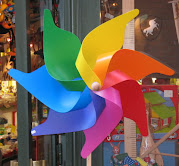
My great WCC colleagues Marc-Henri Heiniger and Muriel Bataclan invited me to talk about the history of the ecumenical movement to group of people from specialised ministries who are at Bossey for some days of quite intense ecumenical formation. I haven't time now to say much about what I said - tho' I did manage to record it on my new Ipad. But our session ended in the sunshine trying to put together the ecumenical river - it's such a good metaphor - the puzzle of ecumenism.
Anyway I also have a video of the group doing this but I think I need a bit of advanced technical assistance before posting that - maybe tomorrow, it's too long as it stands now.
Anyway it was a good experience for me to speak with the group on this topic just a few days before ending my time working at the WCC. As ever it was a real privilege to speak with them and I did promise them I would try to post at least some photos before the end of the day. I also ended what I shared with quite a big plug for social media in building ecumenical capital: be authentic, be active, be nice.
Monday, 26 September 2011
Putting part of the puzzling ecumenical picture together
Saturday, 31 July 2010
Love parade - the ecumenism of grief
I've been reading Wolfgang Thielmann's post on the ecumenical service for those died in the Love Parade. Telling of the tears of politicians during the service he speaks about the ecumenism of grief, about how when Nikolaus Schneider preaches about loss his words are not seen as empty - for he too knows what it is to lose a child. Such moments of mourning bring people together across confessional boundaries.
As I read it I thought again about the fact that sharing grief almost brings us closer together than sharing joy ... so sad, so important.
Monday, 10 May 2010
Neither of us is in any way an athlete but my husband has just won a part share in two gold and two siver medals
 On the stranzblog he is known as Dr B. However in real life he is called Stephen Brown. Late on Sunday evening he learnt from his colleague Peter Kenny that the small news agency they run has won two gold and two silver awards at the Associated Church Press awards.
Anyway, congratulations to Peter, Stephen, David and Jean-Michel at ENI News. you can read more about the award here you can also subscribe to ENI headlines here.
The posters pictured here were put together on our dining table while I was at feminist theology last week. The things men get up to when the women are away.
Here's part of Dr B's article from today:
Ecumenical News International has won an Award of Excellence as the "best in class" religion news service from the Associated Church Press.
"What impressed me about ENInews is the breadth and depth of the reporting," said award judge Leon Alligood, a journalism professor at Middle Tennessee State University. "The writing was well edited and engaging."
The award for work done in 2009 was presented on 8 May to Peter Kenny, editor-in-chief of Geneva-based ENInews, at the annual ACP awards ceremony in Arlington, Virginia. ENInews also received a second award of excellence and two awards of merit for its reporting.
The Award of Merit in the "Best in Class: News Service" category, went to Washington-based Religion News Service, which works in partnership with ENInews in distributing news to other media. An honourable mention was shared by Baptist Press, which was noted for its coverage of Kyrgyzstan and El Salvador, and Presbyterian News Service.
In the "Editorial Courage" section, ENInews won the Award of Excellence for its coverage of the World Council of Churches, one of the four founding member organizations of the news agency (www.eni.ch/featured/article.php?id=3047).
"This is editorial courage at its best - great journalism in the watchdog tradition. Great risk for the writers, but the audience wins," commented judge Andrew Herrmann, the managing editor at the Chicago Sun Times.
Sunday, 4 April 2010
Happy Easter!
We are drinking tea in Pankow following a really wonderful Easter service at the church of the four evangelists which was led by Ruth Misselwitz. What I found particularly heartening were the large number of young families and children at the service which was full, it was traditional and simple and real. I was deeply moved simply to be part of it, to realise how deeply I still know the German liturgy by heart and what a privilege that is too. I'll write a bit about some of my complex Easter emotions later - I was in tears for parts of the service but there was laughter too, as the children stormed back into the church carrying their Easter chocolates, just as the final communion thanksgiving prayer was being said at the altar!
For now I'm a little too close to the emotion of it all and truth be told I'm actually just trying out my new Easter egg, a German vodaphone dongle which means I can connect across borders much more cheaply and practically than via my mobile phone. It took non-technically minded me precisely 90 seconds to set it all up. I'm impressed. You won't be able to stop me tweeting now - must be all those Easter chicks!
Saturday, 27 March 2010
barcamp church and bar camp ecumenism?
 Over on evangelisch.de the new German Protestant web portal they have loads of great ideas and initiatives - they launched the Twitter Bible in German last year which is great fun and now they're inviting people to a "Barcamp" on churches, social media, web 2.0 and so on. It's taking place in Frankfurt on May1-2 and you can find out more here. I'm really quite tempted to go along.
The barcamp idea sounds fun and makes me wonder about how we could build something similar into our international ecumenical meetings. We've got to find new ways of doing things. These days methods and content need to mesh more clearly. For church bureaucracies and hierarchies these new informal and networked ways of organizing, making decisions and doing things are quite challenging. I still rather like the idea of trying to do barcamp ecumenism, an unconference conference sounds like the sort of thing I'd quite enjoy!
Tuesday, 2 March 2010
Reception and annunciation at feminist theology
We were studying and reflecting upon Luke 1.26-38 at feminist theology tonight, the account of the annunciation.
Interesting that a literal translation of the feast of the annunciation from the German Maria Empfängnis would be the feast of reception. Mary receives the announcement, embodies and carries the word into the world - in many ways a Spirit annointed prophet and also the first of Christ's disciples.
One comment on the text came from Jean Luc Godard's Je vous salue Marie in which one reflection on Mary's virginity is "être vierge c'est être disponible" - another way into reception and annunciation.
We read the annunciation this evening as part of our progression into the theme of finding our voice finding our way(voix and voie in French). How do we as women, as women who seek to follow Jesus respond and say "yes", say "so be it" to the call that comes to us from God, from God's messengers? We also asked ourselves "What is the angel saying to you?"
We dwelt for quite a while on the word "servant" (doulos) pondering the meaning of being slaves to the word, talking about service to the word not being the same as servitude.
What came through in many of the responses is how our understanding of Mary is that she is no doormat but that she is "upright and going forwards". The call she receives is a call to trust.
I felt challenged by our communal reading to say that I was hearing something along the lines of "do not be a slave to your work, enslave yourself rather to grace and trust". I'm still not comfortable with the slave langauge but the liberating out of servitude langauge did wokr for me tonight.
Coming home I've also been thinking about speaking and listening as part of the "reception - annunciation" dynamic. Communication, communion, carrying forth the word - the internalising and externalising of the good news. I do also wonder how virginal I am, how "disponible", how available, how open ...
And finally, reading the Bible with others is good for you. It would be fair to say that I was not in a happy state at the beginning of my evening but spending time talking about the Bible, faith and our lives lifted my spirits and granted me, albeit briefly some perspective. So feminist theology is good for the soul - but then I never doubted that any way!
Friday, 26 February 2010
Reuters, Protest info and more
 Olav Fykse Tveit, who has now been in post at the WCC for six weeks held a press briefing this week prior to his official installation as general secretary on Tuesday evening.
I attended the briefing to interpret which was fun and also a privilege (it was also work of course!). You can listen to what Dr Tveit had to say about his ecumenical vision, about Haiti and debt cancellation, about the Middle East and about Climate change by clicking on the audio links here.
It's been good to see that we had some pick up on Reuters Faith World blog. epd in Germany and some of the Francophone Swiss media have also written pieces following the press briefing.
It's good when interpretation can serve communication, I almost feel useful!
Meanwhile the sermon on the ecumenical movement of the cross preached by Tveit during the installation service is available in English, German, French, Spanish and Russian, though not yet in Tveit's mother tongue Norwegian. Perhaps we'll have to add some new translators to our lists.
Saturday, 31 October 2009
Information is not communication
 I am not quite sure how this happened but today, after a quick flit around the Ferney market, post office and pharmacy, we headed off to spend a bit of time in Geneva, particularly Plainpalais and Carouge. I needed to buy tights and succeeded in doing this, but somehow after a lovely time at the Carouge market and the café du marché, we seem to have arrived home with about 8 more books. Fortunately they are for the most part not too long so I hope they won't distract me from the writing I am going to do this weekend.
Dr B bought me Dominique Wolton's Informer n'est pas communiquer from the Librairie du Boulevard. Wolton has his own site here filled with lots of great quotes.
The essay contained in the book points to today's challenge of "information having become abundant and communication rare". Although I have not yet read the whole essay, each page I turn to has thought-provoking aphorisms which help me think about my work as part of a communications department:
"Emphasising that communication and the funcitoning of the public space are about living together, is also to reflect on the need to manage both the inherent differences in our societies and the upholding of a principle of unity, with the perspective of renewing contemporary characteristics of the society" p. 33
At the end of the book (yes ok I admit it I am one of theose dreadful people who often looks at the end of books before having read the middle) Wolton looks at the issue of the environment in particular and says that "this is why information and communication are such important questions at the beginning of this century. Questions of war and peace."
On his website Wolton has this quote which I think sums up his approach brilliantly
"L'information va de plus en plus vite, la communication toujours aussi lentement."
(Information is going faster and faster, communication still goes just as slowly as ever)
Tuesday, 4 August 2009
Word of the day l'auberge espagnole
It is no secret that I am not a tidy person. My other quite particular and tidy translator colleagues doubtless despair of my mess sometimes. However, all it takes is a visit to my husband's office to see mine as a fairly orderly space. (He'll probably edit that last sentence to oblivion within moments of reading this!)
"Auberge espagnole" is one of those nationalistic little phrases that get into languages - like to take French leave (the equivalent in French being to take English leave - filer à l'anglaise). The implication is that a Spanish hostel or inn would be a bit chaotic, a bit of a hodgepodge, a place where you have to take pot luck (by the way a pot luck supper in French is called a repas canadien).
I have also seen the term auberge espagnole used as a congretational model for churches - not trying to be all things to all people but trying to offer different ways in to faith and being church. Of course it appealed to me - perhaps a subtitle to be blog should be auberge espagnole, what a shame I don't speak the language!
Since my time at the CEC assembly I've been pondering what an auberge espagnole model of communication might look like. As we set up the communications work for the assembly I was quite excited by the fact that we had freedom to try and get messages about the assembly out there. It was fun to encourage people to blog or tweet - to offer thoughts, concerns, campaigns or groans and not try to control or santise things. It was very energising and generated quite a creative space that may have looked chaotic but actually led to everyone working as a team on the different parts that made up the whole.
In terms of the work I have been doing on leadership I suppose it's a bit like the three-ringed circus. It's very different from the control approach to communication - of which I suppose the Lambeth conference last year would be a prime example. (I leave Dr B to comment on that as he was there and found it extremely frustrating.)
Of course any good communicator will need a bit of both - a bit of the auberge espagnole approach and a bit of the control approach. The control approach can unfortunately have its roots in fear and sometimes leads to never daring to communicate anything. The auberge espagnole approach could be seen as muddled and it does rely on high levels of trust within the team.
Whether choosing a control or an auberge espagnole model for the work that's being done, working on building trust in congregations or organisations of any kind is never wasted. As I begin to contemplate the writing of my diploma for the Craighead Institute I am more and more interested in the role of "intangibles" like trust, confidence and motivation in organisations. Vision, leadership and integrity of purpose can offer inspiration for generating trust and other intangibles. I suppose that may not sound like the picture of a church near you, but I'm learning that even healthy organisations are not perfect!
Saturday, 4 July 2009
Beads, remembering, friendship and hugs
On Friday evening a group of friends were invited to a special time of farewell for a colleague who is going "back home". This happens alot in Geneva, people stay, build friendships and then move on. The international population is very transient. Goodbyes are not often as powerful as this and it's easy with a constantly moving population to get a bit nonchalant about parting.
On Friday as we gathered we had prepared beads and strings. We each added a bead and a memory to a red string for our friend and we listened to her and to one another. We told stories, old fairy tales, tales about one another, we cried a bit and laughed and sometimes sang and remembered good times and difficult times. We each also created a thread of beads for our friend to take home.
One of us told about how in her culture beads are often used as a way of saying things without words. A woman might leave a string of black beads on the pillow as a way of saying to her husband "we need to talk".
We talked about life and families, work and friendship, values and how painful it is to hide who we are for the sake of our work. That group of people will never gather in quite that same way ever again. It was a time of authenticity, a time of farewell. I got a sense it helped all of us to reflect on our lives and on our work, but it also helped us to pick up the thread of our lives and to move backwards and forwards into the future. Saying good bye is not easy at all. Watching others leave when you remain is also hard. For leavers and remainers the beading helped to find more understanding of how all of us are moving on even as we stay put. We hope our strings of beads will say something beyond words about the love and friendship we have shared.
Sunday, 21 June 2009
Dreaming of relevance or maybe going viral - just how do we change the world?
Over the weekend I was thinking about the dream of being relevant or having impact. Over a late lunch today with a friend who has worked in international emergency work and is now in development communication we talked in a bit more depth about various aspects of having an impact. How emergency aid workers are trained to not try and resolve anything other than the immediate problem - food shelter and water for today. Impact is in the here and now, it's about today and not about changing things for ever.
How do we change the world, have impact, touch others with a message that we passionately believe is important? Is celebrity for an idea or an individual the answer - going viral on You Tube the only mark of success? (Watching the media circus of recent months around Susan Boyle has hardly been edifying.)
At the beginning of my year of theological studies in the former GDR in 1989 our course tutor read from and encouraged us to read further Manfred Josuttis' Der Traum des Theologen (published in 1988). It begins with a preacher dreaming about preaching to a packed church, condemning apartheid and the people applauding - a real dream of having impact or resonance. I can still remember the woman next to me muttering under her breath "this is a very macho dream of adulation". Later that autumn there were a few brief weeks when the churches were packed, when the words of many pastors and church people in the GDR were listened to and applauded. Then the Berlin wall came down and the churches gradually emptied again.
The desire to have a big impact is no doubt very human - as is the desire to say that the small impact we are having is more significant than it really is. This need to live the dream of relevance often blinds us to the reality of needing to get on with humble, incarnational work - writing, talking, listening, studying. The lasting relevance of what we do will be in the quality of our message, the integrity of our vision and in the relationships we build, and not necessarily in the brilliance of our fine preaching or super-packaged gimmicks.
Saturday, 18 October 2008
Saturday evening Catholic eucharist
The French refer to it as "La messe anticipée du samedi soir" which I suppose is a way of saying you have been to Sunday service by going to the Saturday evening service that uses the Sunday readings. If you're not Catholic this may seem a bit strange but I suppose it means that you then have your Sunday free to do other things.
For the first time since the course in Rome began a Saturday evening eucharist was organised in the church of the congregation where our meetings take place. It was a simple, straightforward but beautiful service, and I'm pleased I attended even if I did not in the end actually "communicate". Not an easy decision and an emotional one but it seemed like the right one at this time.
I'm not sure my reasoning on this is completely coherent but here are some elements that led me to discreetly remain in my pew this evening.
Worship is a public event, even in a small community, I work for an organisation which works for Christian unity and I didn't want my personal desire to partake in the eucharist to be misinterpreted. Similarly, when you get ordained, in some ways - particularly within church settings - you are not a private individual in the same way a lay person might be. Somehow, fasting from the bread and wine is also a way of fasting for greater and deeper unity, entering into dialogue about the issues - this is not about "individual conscience" for me. (A phrase that the Roman Catholic Church sometimes uses about the issue, i.e. non-Catholic individuals should decide for themselves, although actually the church has already ruled and does not allow its members the same freedom of conscience at Protestant eucharists ... hmmm). I realise this must seem rather inchoate, but as our group had also been talking about dialogue these past two days and insisted on the fact that dialogue is not necessarily harmony, it seemed right for me in this instance to stay true to my convictions.
What was very beautiful about this evening's service was that the patten and chalice were left on the altar and the communicants simply filed up and stood where the priest had stood to take communion. A very powerful symbol and beautiful to be part of, even only as an observer. It also made my decision harder in some ways - it is rare to receive both bread and wine at Catholic mass and the way in which it happened had a certain Protestant simplicity.
Tuesday, 14 October 2008
Trust as the essential ingredient in management
 On Wednesday evening I shall take the train to Rome to begin the second year of my course on management with the Craighead Institute. I'm trying to get around to sorting out the title for the long essay I have to write for the Diploma next year and have been trying to read around the topic a bit. Over the past week I came across this article on Trust, Confidence and Organizational Brain Disorder by Theo Compernolle.
The thing that is beginning to interest me more and more as I go into the study of management is that is is really like psychotherapy but for organizations. French talks about associations and organizations as "une personne morale" - this really simply means a legal entitiy - as opposed to a "une personne physique" which is an individual (Don't translate these as moral person and physical person - you're likely to get even more lost in legal jargon!). Although the concept of une personne morale was a bit difficult for me to get my head around as I begin to understand organizations as living, breathing and irrational entities it begins to make a bit more sense.
Anyway, here are a couple of quotes from Compernolle's article:
Trust feeds on virtue, so be virtuous. Your words and actions should reflect your values. Keep your commitments and promises. Admit your mistakes quickly, without any “buts,” and right wrongs fast. Be forgiving.
Interestingly this is almost religious language and this next quote could almost come from the book of Proverbs:
Effective communication builds bridges. Communicate by listening 80% of the time, but don’t forget the other 20% – dedicated to active communication, using clear and simple terms and metaphors. Make time for live contact. As an active communicator never criticize in public and do not engage in negative gossip. Instead, spread lots of positive gossip and be good at giving and receiving positive and negative feedback.
Saturday, 11 October 2008
Sow life, and kill death with life
“Because you can’t kill death with death
Sow life
And kill death with life.”
In his speech, he recalled how he had once been a translator for a Mayan pastor and a delegation of theological seminaries from North and Central America visiting Guatemala after the 1996 peace accords that ended a 36-year civil war.
I noted to myself that the pastor did not trot out his credentials of suffering. I knew he had lost close relatives. I knew he had witnessed monstrous acts.
The pastor and I talked later. I asked him why he had chosen not to tell his own story. Such memories, he told me, should not be violated. To do so can trivialize the victims, can cheapen their ongoing presence as they accompany us on life’s journey. We talked about living in a time of great violence.
We agreed that in these circumstances, there are no good guys. Within each of us exists the capacity to do monstrous acts. That is who we are as human beings. To celebrate violence only lessens us, no matter what the justification. But victimhood also lessens us. To perpetrate violence breaks something inside us. Always. There are no exceptions.
So here we are, lessened: victims, witnesses, perpetrators. After so much brutality, our very humanity hangs by a thread. God’s restoring grace is our only hope. So how do we deal with continued violence and injustice? Do we just step aside and let it roll unchecked? No. The struggle to build the world imagined by God must continue.
But we must know that the struggle will consume us. In our brokenness we will become even more broken. Holy Spirit, spirit of wholeness – we are broken. We are capable of breaking others. ..
And quoting Esquivel's words above, he concluded:
This is the story we share: the breath of the Spirit is in our midst; her presence will not be denied. Her's is the story of the slow, sure, tender triumph of life and justice and hope in all of Creation.
The full text is at stranzdocs
Thursday, 2 October 2008
The Bible Style Guide
 Thanks to ENI I found out about the Bible Style Guide today - this is not about biblical sartorial elegance but is an attempt to offer a crash course on the Bible to journalists and media types:
The Bible Style Guide is a reference text designed specifically for those working within the media industry. It provides a crash course in the Bible for busy journalists, broadcasters and bloggers.
Packed with useful facts and figures, it includes handy overviews of issues that often hit the headlines, as well as terms that are often misunderstood. Whether you’re covering Creationism or Zionism, or want to know your apostle from your epistle, The Bible Style Guide is here to help you get started.
And ENI says this:
"Whether you are covering Creationism or Zionism, or want to know your apostle from your epistle, 'The Bible Style Guide' is here to help journalists get started," said David Ashford, the interdenominational Bible Society's media development officer, who wrote the guide.
Observers say the choice of the title for the handbook may reflect the hope that the 75-page work will find a place on journalists' reference shelves rather than being lost in the avalanche of information that pours into newsrooms.
Among the questions the guide addresses are, When was Jesus really born? Is intelligent design the same as creationism? How do Christians deal with violent texts in the Bible? How many books do the different versions of various Christian denominations contain, and who decided what should be included? The main section is a 20-page A-Z glossary.
You can download the Bible Style Guide 2008.pdf (2.4MB) or, if you are a working journalist in the UK who would like a hard copy free of charge, get in touch with the Bible Society.
Saturday, 20 September 2008
Gardening with Martin Luther ..and Roman Catholics ... guest post

Sunday, 7 September 2008
St Paul's press officer ...
This morning I preached at one of the Genevan Anglican churches for the meeting of the press officers' network of the European churches (PONEC).
You can find my sermon here, in it I wonder about how very good St Paul's spin doctor must have had to be.
Towards the end I also mention Laurent Schlumberger's excellent book Sur le seuil - les Protestants au Défi du témoignage - on the threshold Protestants faced with the challenge of witenssing to their faith. In it he argues for a renewal of bearing witness to our faith in a way that is honest about doubt but also doesn't get lost in intellectual discussion forever. I forgot to add in the sermon that Laurent moved from being a regional president in the Eglise Réformée to serve as minister to a "mission populaire" in Paris. Witnessing to faith is not (just) about writing books but really about getting onto the threshold and amongst the people.
Writing the sermon and revising it I thought about how hard it is for people to deal with conflict in the church - many of us cannot cope with muscular discussion. Over the decades our culture of debate has become less feisty. Just as society is becoming more diverse and plural we actually seem less able to cope with debate and disagreement. Easier to reduce church for praying and listening to nice things about God.
Anyway as ever I digress, here's how the sermon ends:
"Before I finish I’m afraid you are going to have to allow me one final linguistic aside. There is a wonderful German word Schwellenangst – it means fear of the threshold, fear of knocking on a new door, doing a new thing, being on a new threshold.
But God has not given us a spirit of fear of the thresholds where the witness to our faith takes place, but a spirit of dynamic power, passionate love and wise discretion.
So may God's Spirit truly blow a hurricane of wise discretion, love, and power calling us to live on that threshold where we bear witness to the faith and keeping all of us - 'on message'."

 Posts
Posts