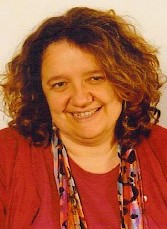
It had not been easy to find a date to go out for a drink together, and I was quite surprised that I was expected at the ecumenical centre reception for 17.00, I even got an sms reminder. Wow we must be having some serious fun ahead of us starting this early. In honour of a night on the town I even put on some mascara - with hindsight this was perhaps not a good idea!
I met with Maike and she took me not out to the bar but into the chapel - that place of course for the real gluttons and wine bibbers! In the side chapel were quite a number of my colleagues gathered very quietly and Maike explained that they simply wanted to say thank you by organising Holden Evening Prayer in such a way that all I had to do was to be there.
I was very moved - hence the problems with the recently applied mascara and the depserate search for a hankie in my bag (I've learnt from facebook they had even discussed this eventuality before my arriving - this of course is what friends are for).
A group of my friends had been preparing for a long time, rehearsing the piano and flute and solo parts since August, tonight was the first time they sang and played together. It was a very beautiful moment, and the liturgy should be beautiful but not perfect. I thought back to Stephen and Sara Padre, Itonde Kakoma, Luke Smetters, Colin Williams, Annie Osbourne, Michael Wallace and many others who have introduced and sung Holden with us since 2004. It is so good to know that the singing will go on, especially as more musicians know the parts. It reminded me of all of those times when I have come to the end of very busy days in the office and felt that perhaps the most important thing I had done was pray with others.
Tonight was truly "leitourgia" - the work and praise of the people, many were involved in reading the wonderful selection of Bible verses chosen by Ruthann, in the music, in the preparation. I know how much coordination that takes so I felt very blessed.
The liturgy is the space that frames our grief, joy, distress and doubt. This was the space where I could finally allow some tears to fall in public as I grieve at leaving a job I love, recognising my failures, seeing too some achievements and simply accepting that moving on is painful at this time. Tonight my tears were for the first time about leaving these wonderful people and this wonderful space, rather than tears about that which is broken in the present and the past. No more struggling is needed. Singing and praying to God held all of us in that moment together in love.
This was the second time this year I have received a sign of pure grace. It is quite hard to receive such creative, simple generosity. But I realised that grace has that capacity to transform and heal. The thirty minutes of tonight's service was a special gift to me, nourishing me with joy despite the tears.
Thank you all very, very much.
And so to Paris where I hope to occasionally say the Beatitudes with others at midday according to the tradition of les veilleurs.
But for now simply gratitude.
Tuesday, 27 September 2011
Beauty, surprises and the generous liturgy of friendship and prayer ...
Monday, 4 July 2011
Fragments, mosaics, patterns ...
For quite some time I seem to have been dwelling on fragments, fragments of lent and Advent. Bits and pieces, scraps of cloths, small quotes, kennings, beginnings of ideas, theology of fragments, an ecumenism of fragments ...
This evening I went out to supper with a friend and was given a very special box covered in tiny fragments of beautiful wood and precious mother of pearl. I couldn't stop running my hand over it, so pretty, so lovely, Not perfect but simply beautiful.
I talked about the fragments and my friend began to speak about the importance of mosaic in her culture, how it offers a different approach to melting pot multiculturalism. In the culture of the mosaic each shapely fragment is valued because it is used to make up part of the pattern. The fragments are part of a pattern.
In a way I cannot even really put into words I found this deeply meaningful today. It was both reassuring and grace filled as an idea for me. As I try somehow to gather up what I feel is shattered and put it together it is purposeful to feel that these shards of precious life-giving colour may actual produce pattern, pattern that may even be aesthetically pleasing or spiritually meaningful.
The fragments may yet come together in a new whole, that too may of course be shattered. Yet the patterning and the yearning for meaning and beauty will remain.
I realise I have been blessed.
Meanwhile I must try to find more of Henning Luther's writing in the theology of fragments.
Sunday, 22 May 2011
Silence or applause - really in so many ways it is about how we put our hands together
 Our very good friend Paul Oestreicher has travelled from New Zealand together with his wife and fellow peace activist Barbara Einhorn to be here at Kingston. In the 1980s, back in the days when Dr B was the Campaign for Nuclear Disarmamment's international officer the three of them worked closely together, particularly on the German-German working group of END, European Nuclear Disarmament. The peace movement was important and faced political difficulties in both parts of the then still divided Germany. As I look back now I can see that the pain of that division on German soil gave birth to a very engaged peace movement, of course the experience of the war also drove the 1980s peace movement and pacifism in Germany forwards. Paul's personal story is similar to that of my father's - both fled Hitler's Germany in the late 1930s.
In the heat of the Jamaican sun Paul cuts a very elegant figure around the campus here in Jamaica in his light long white clothes. At the opening plenary he gave an inspiring, heartfelt and challenging speech "A New World is Possible - a cry for the end of war".
Here are some extracts:
Wherever you come from, whatever your church tradition, you may be Orthodox or Catholic, Protestant or Charismatic, Evangelical or Liberal, Conservative or Radical, all of us have come here because we wish to be friends of Jesus, rabbi, prophet and more than a prophet. To each one of us he says: You are my friends, if you do what I command you ... This I command you, to love one another as I have loved you. Is anyone, anywhere, excluded from that love? Here is the answer that Jesus gave to his friends: It is said: ‘you shall love your neighbour and hate your enemy’; but I say to you, love your enemies and pray for those who persecute you.The other interesting dynamic to Paul's speech was that when the WCC's general secretary introduced him we were requested to follow the Quaker custom of not applauding either at the beginning, during or at the end of the speech. In the context of our meeting here in Kingston this didn't quite work, applause at large events like this is often the only way that "ordinary" people can participate. I can see why Paul requested that - Quaker meetings take place in silence unless one is moved by the Spirit to speak - Paul is both a Quaker and an Anglican priest. Part of me wishes that we could have simply greeted his words with silence. That silence might somehow have "decanted" the truth and the message in the words. It is easy for speakers to play the crowd for applause and sometimes it can change the tenor of a speech, feeding of the rapture of the crowd. Silence doesn't always mean disapproval, it can also lead to a deeper consideration of what has been said.
Jesus was not an idealistic dreamer. He was and remains the ultimate realist. The survival of our planet demands nothing less than the abolition of war. Albert Einstein, the great physicist and humanist, recognised that early in the last century. He repeated it often with a clarity and credibility that few Christian pacifists have matched.
What I have put before you in stark simplicity, is nevertheless deeply complex. Having spent my life studying politics, I do not believe that there is any room for pacifist self-righteousness. I have not come to Kingston to demonise those who choose the military option. They are part of us, they are the many and we are the few. We must find ways of co-opting them into the peaceful struggle. The critics of principled non-violence are neither knaves nor fools. We must answer them wisely and patiently. They will rightly ask pacifists like me many serious questions: how, for example, is law and order to be maintained globally without heavily armed nations? On this point there is already good news. In the light of the last century’s history of unparalleled violence, international law is paving the way for genuine alternatives.
In the end we were not able to resist responding to Paul's speech with applause, it was a very measured performance but a bravura one nevertheless.
Now we need to decide how we will put our hands together to respond in practical ways to work for the abolition of war. Our hands must not then remain silent.
Photo copyright (c) EKD/epd
Tuesday, 26 April 2011
Easter blossoms, church going and festivities ...

Menu:
Starters and appetisers
spicy beetroot blinis
Lightly poached green and white asparagus
fresh organic turpips
Italian plum tomatoes with basil
homemade mustard and balsamic mayonnaise
sour cream
Main course
Roast lamb
new potatoes
broad beans
gravy
Cardomon, pistacho and turnip greens fritata - the vegetarian option
Cheeses
Bleu de Termignon
Stilton
Laguiole
brie à l'ail de l'ours
desert
chocolate mousse
strawberries in cointreau and passion fruit
Coffee - much needed!
find our wine here!
Monday, 11 April 2011
Of tears, laughter and flowers ...


 It is desperately hard to explain the personal pain one feels to someone else, and in some ways it is quite pointless yet of course entirely necessary. You can tell that one part of my reaction to the pain I myself feel comes from that British stiff upper lip school that doesn't let much hang out. The other part of me though speaks freely, perhaps too freely about how I feel. I can see how my pain shocks people, makes them step back and really - whatever their origins - hope that you will be well-mannered enough not to mention such distress again over the post lunch coffee. Hmmm ...
Today someone really saw my distress and didn't avoid it, he put his hands on my shoulders and showed compassion, he wasn't frightened by my pain. As that happened, I thought, thank God. It was quite a relief.
And then, as is the way of life, my stiff upper lip kicked in again and I decided I wouldn't write too much more about that side of things. Let's just say it's been a day when tears have threatened to dominate - even while I've been preparing budgets. It's a very strange state of affairs but oddly I've begun to realise too that just like when I have a cold I blow my nose, now too so long as I have enough hankies available, I can continue even if the computer screen looks a little blurry now and then.
Meanwhile, I also today heard a good and for me moving and invigorating sermon from my colleague Deenabandhu Manchala. Given that yesterday morning in church we had experienced one of the worst ever sermons, this morning really was a blessing. Bandhu spoke about how joy and the capacity to rejoice are signs both of resilience and of resistance. He preached on the text from Philipians 4.4 "Rejoice in the Lord always and again I say rejoice"
To be able to rejoice, to smile and be hopeful amidst fear, loss and adversity is a gift, a sign of resilience and of profound inner spiritual strength. It asserts that the spirit of life has the final word over the forces of death.Listening to Bandhu preaching about the power and resources of joy I felt myself smiling and I also felt something of the Easter promise burning through into our Lenten reflections. I have often preached on "Easter laughter" but I had never take Philippians as my text. Lost in the pointless pain of depression it is easy, far too easy to forget joy and laughter, and their restorative resurrection values. I have been fortunate that throughout my own pain I have continued to be able to laugh and be joyful at least to some extent.
We can only rejoice and be happy when we have no fear. When violence is caused by the fear of the powerful, let us not preach non-violence to the victims, but in obedience to God, let us preach non-violence to the structures and cultures and to the agents of death and destruction. Let us call them to repentance, telling them to ‘rejoice in the Lord’, and not to fear and act violently, to submit themselves to God's sovereignty and peace. Let us therefore attempt to bring hope in the lives of the threatened through a discipleship of resistance, and transformation. Let us strive for justice and wait for peace to sprout and flourish.Meanwhile we had some surprise visitors on Saturday afternoon who brought us flowers from the mountain top. It was an act of spontaneous pleasure and joy at having found such a perfect meadow on their part and we were the first people they knew on their way home. It was a lovely moment to see them standing there at the door, holding out the pretty posy pictured here, and to know with a smile on my face and a slightly sinking heart, that I had 10 minutes earlier decided to put off tidying the house for a little while longer ... aie! However, many who have experienced the untidy houses I have lived in may think that my levels of embarassment have perhaps not quite reached the required level for ensuring a tidy place!
The flowers from the mountain top will have faded and wilted by the end of the week but their meaning for me, the memory of their fragility and the smiles with which they were offered will remain. "Say it with flowers" the adverts used to say ... yet there was much that was unspoken in this small bunch of colour we received and which I placed in our favourite jug. So the yellow daffodils and the purple vetch speak for all that cannot be, for those things which cannot be said, for the deisre for joy even when this seems far off, for the promise that fear will truly be overcome.
For such small fragile yet powerful signs I give profound thanks.
Thursday, 20 January 2011
The darkness is also holy ...
 Do not fear, for I have redeemed you;
I have called you by name, you are mine.
When you pass through the waters, I will be with you;
and through the rivers, they shall not overwhelm you;
when you walk through fire you shall not be burned,
and the flame shall not consume you.
Because you are precious in my sight,
and honoured, and I love you ...
A year ago I was quoting that passage from Isaiah after a mainly sleepless night in the hospital with Dr B. Tonight I came home to a gourmet meal he prepared and we have gently celebrated the fact that one year on he is alive, very well and looking to the future.
Meanwhile at the end of the working day today a good friend visited me on her way home. We talked about spirituality, prayer and wisdom. Sometimes I feel as if my own recent pain has torn not only hope but also wisdom out of my soul, so it was good to have a conversation about the darkness also being holy, about wilderness spirituality.
My friend spoke to me about the book Dear Heart Come Home - midlife spirituality. As we exchanged pain and hope, frustrations at the excesses of patriarchy and much laughter besides I began to piece together some small piece of hope and I switched off my computer and came home. Work will still be there in the morning. As a walked out the strong Geneva icy "bise" nearly took my breath away, a reminder winter is still very much here even if the recent week has seemed almost springlike.
Today truly I have so much to give thanks for. Sometimes gratitude is a hard and stony path of darkness, but it is a holy way and I trust it may at last lead to something that looks like hope.
Saturday, 11 September 2010
Notes from the Hall of Uselessness - words of adieu for a dear colleague on retirement

 Next Tuesday my very dear colleague Rosemarie Dönch will retire, technically she doesn't retire until the end of the month but she has much deserved holiday before then. Rosemarie has been the WCC's German translator for 39 years and is like a walking terminology database. It is a little bit like having our dictionaries walking out of the door. Below is some of what I said at her leaving party. She herself wrote and read a lovely poem in French (the lingua franca as she said of our small and now smaller language service) and Theodore Gill also prepared a very funny poem which I'll share later.
While I was in London I came across the "Cahiers Series" from the American University of Paris center for writers and translators. I bought two of them as a small present for Rosemarie. The title of the first booklet became the focus of some of what I tried to say ... is our writing and translating just years of notes from the hall of uselessness ... perhaps ... anyway you can raed more about the Cahiers here and here.
“Notes from the hall of uselessness”
Rosemarie
You and I know that
“Übersetzen ist wie dichten aber schwerer“
And I realised how true this is just trying to translate this one short sentence:
“Translating is like writing poetry just more difficult.”
I think it would be fair to say that most of what we receive to translate here is not very poetic but I also know that over the years some of the translation you have most enjoyed doing and coordinating has been of poetic texts.
For thirty nine years you’ve been doing this difficult job in this wonderful and difficult place, and as I consider that I say in French “chapeau”. I recognize the extraordinary discipline and attention to detail that represents, the years of discretion and humility spent trying to get a good German version out of other people’s texts (often, very often, improving the original English on the way). Today I want simply to say how much I admire your calm, rigorous professionalism, your staying power and also the pleasure you obviously have in doing an interesting job well.
When you leave we will all have to hunt high and low for quotations and footnotes, you simply know not only which assembly people are writing about but often which chapter of which report they are quoting from. I’m not sure how we’re going to cope. We always knew that you were irreplaceable now we have the proof.
I am however delighted that in recent years you have been able to train and share your extraordinary knowledge with a younger generation of professional translators particularly as we prepared the terminology project.
But at the same time as I say “chapeau” I also admit to wondering what it is that has kept you going over all these years and realized – perhaps rather theologically - that it was the word or rather words that gave you energy. Love of language, love of trying to sculpt accuracy and readability. Translating is both a skill and a vocation, it is sometimes frustrating but often both calming, satisfying and intellectually stimulating – we are always looking for the right word, learning new words. Translating keeps the brain young and I am sure that love of language will also be something that continues to give you energy in your retirement – though I am sure you will be delighted to never have to translate the changes to the WCC’s constitution ever again!
There is only one constant truth in translation – however well and however much you translate, people will only ever notice the mistakes!
I need to be careful how I put this - but I have a sense, based on several years experience now, that some German church people notice mistakes more … I think I won’t say more other than to add that I am glad that I have not been having to translate into the mother tongue of one of our general secretaries! Once more “chapeau”!
And now for the Notes from the hall of uselessness …
The translator and writer Simon Leys (the pen name of Pierre Ryckmans) has put a name on his study door “the hall of uselessness” – saying something profound about keeping an essential humility about all the words we try to produce, all the translating and communication between cultures and ideas we try to achieve.
And at the same times as that reminder of humility I also wanted to give you something rather more transcendent, Translating Music by Richard Pevear, a promise that there will be time in retirement for new languages, new melodies, new words … the two books might encourage you to perhaps take up classical Chinese or Russian.
However today I noticed that you have renamed your office and have put the fire escape notice with your day of departure on your office door!
Hmm … we really do not want to see you go. Please come back from time to time, eat with us and tell us about the new words and worlds you are discovering.
May retirement bring you time for reading, for poetry, for writing and for many walks in the botanical gardens. Many thanks for your contribution to the ecumenical story.
Leb wohl liebe Rosemarie!
Monday, 30 August 2010
Arrivals, departures and blessings ...
There are many people in our circle of friends moving on from Geneva at the moment. Fortunately there are also others arriving but for now the round of leaving parties is in swing.
I am not good at such events, not clever at saying good bye and not great at keeping in touch with folk.
Today a leaving colleague kissed me goodbye and smiled gently at me. She offered me lovely affirming words about the importance of the work of translation and told me what her memory of me was ... I realised afterwards that I had been blessed in a very special way. My friend promised to pray for me and asked also for prayers herself ... a reciprocity of need and dependency on Anne Lamott's "whatever" and "ah well" ... ahh prayer ...
And I recognised within myself as so often my ability to be moved in my mind and yet somehow never let the consolation of such blessing touch the depths of my spirit. Why am I so resistant to letting myself be consoled, do I believe I don't deserve balm?
Tuesday, 20 July 2010
Congratulations to our friend Karin Achtelstetter - new general secretary of WACC
Exactly 6 months ago today our good friend Karin Achtelstetter was ordained in the chapel of the ecumenical centre. That was the night Dr B was taken to hospital ...
Today the news that Karin will be moving to Toronto to take up the position as general secretary the World Association of Christian Communication. Congratulations Karin. Delighted for you, pleased to see a woman appointed to a leadership position.
Sad of course to lose you from Geneva and already in October 1st but looking forward to coming to Toronto to see you there. Good luck and Gottes Segen!
Sunday, 4 July 2010
Saying goodbye ... sort of ...
The Lord will keep
your going out and your coming in
from this time on and for evermore. (Ps 121.8)
I seem to have been saying goodbye to people rather a lot over the past eight or nine months. I'm not very good at it - perhaps it's my way of resisting change - if I don't say goodbye maybe folk I really like won't move on! Silly really because I'm also a person who has moved on quite often in my life.
Tomorrow morning our friend Colin Williams will preach at the ecumenical centre before moving away from Geneva and going to be team rector in Ludlow, a beautiful historic town which is part of the distant view from my parents' house. Colin is going "home" - even if in many ways for him home is further north in England. As I prepare to say good bye to him, part of me is sad to lose another good friend from the propinquity of my daily life here in the bassin lémanique and another part of me is jealous of his sense of "home".
Last year I also nearly went "back" to work in Britain, but decided against it right at the last moment. I didn't write about that here for all sorts of reasons - it was a bit of a personal crisis for me - a difficult time and one which made me realise just how much France and perhaps in particular the French Reformed Church are where I feel "at home", at least at this time in my life. If I move away this is the base I feel I will come back to.
About 12 years ago a very good colleague who ministered in a neighbouring Reformed parish (please note "neighbouring" in the French Reformed context tends to mean between 60 and 100km away!) moved to a new charge in the south of France. I remember putting the phone down after speaking to him and his wife just before they moved house and bursting into tears. I was sad to lose a colleague and sad too because in ministry life is so full that it is very hard to find time for friendships with other ministers. What we had had was a rare time of what the French call "complicité" and it ended when he moved away. We're still pleased to see each other when we meet up, we still occasionally share a great book with one another by post. But work and the regular daily contacts in our lives mean that "complicité" is simply something from the past to give thanks for. I still miss him and miss the way we worked together and the way we could have gone on working together. My tears were also an expression of the loneliness of ministry - it's not easy and it sure ain't easy without colleagues you can trust.
Sometimes today too when people move on I grieve for a future that will no longer be.
They say that home is where the heart is and if that is so then each of my friends who moves away and onwards - to Canada and New Zealand, Romania and South Africa, the UK, Germany, Finland, Norway, Brazil, Kenya ... - takes a bit of my heart and my sense of home with them. In the 12 years since my friend and colleague set off for ministry in the south of France the only compensation for saying goodbye that I have found is that sometimes relationships with those who move away actually become deeper. Facebook, sms, email and fleeting visits means we actually exchange more ... but this isn't always the case. So perhaps I shall have to try to find my sense of "home" in the relationships and put a bit more time into building those up. In the meantime I should certainly learn to say goodbye in a more heartfelt and generous way.
Saturday, 20 March 2010
Alfajores for life!
 Yesterday our household received a very special "care packet" from Délices du Sud. In it were two kinds of delicious home made jam - strawberry and spiced pear - special "thé de songes" ( the tea of dreams) and some of Gabriella's utterly, utterly irresistible Alfajores pictured here.
There is one left. Stephen is currently upstairs but I suspect he would notice if I ate it - we don't even have a cat I could blame if it disappeared ...
Anyway it's good to have friends who are so generous with their time and thoughtfulness.
Saturday, 13 March 2010
A poem about me by Ruthann Gill
The Joy of Mess
Jane IS the joy of mess,
and professes she can be no less.
so daily she creates and must confess
to soaring in joy through the mess!
My wonderful and supportive friend Ruthann Gill wrote two short poems about me this week to cheer me up. This first one really made me laugh. Just be glad you are not the one who has to try and find something in my office!
Sunday, 7 March 2010
Linking all things ...
Everything is linked - Per Harling
Every breath is sacred.
Each pulse is the beat of everything.
Each step is a step together.
Each individual case is universal.
Each wound is everyone's pain.
Each cry is everyone weeping.
Each cry of giving voice to the earth,
for its sorrow and lamentation.
Everything is linked; earth with sky, I go.
Everything is linked; the life of the body with the life of the soul.
Sometimes, somewhere out there there is great solidarity. This ad hoc translation of one of Per Harling's Psalms was sent to me over the weekend. Along with reading detective fiction and teaching the young people it has helped to lift my spirits and encourage me to face the new week. It is good to have friends.
Tuesday, 16 February 2010
Sidney writing from Afghanistan at change.org
Our friend Sidney Traynham has grown a beard in recent months, though we only know this thanks to his facebook picture. Sidney is currently working in Pakistan and Afghanistan and is writing regularly on War and Peace at change.org. What he writes is humourous, thoughtful and thought-provoking. This is what it says abotu him on the side bar:
Sidney Traynham is an aid worker and writer working in Afghanistan and Pakistan. Over the past several years he has lived and worked from Geneva to Zimbabwe -- while reporting from disaster zones in Africa, Asia and Latin America. He is hopeful four days of the week and practical the other three (though he doesn't think hope and practicality are mutually exclusive).Meanwhile I recommend his piece about condoms vs. viagra for bringing a smile but also making a very serious point. As do all the best stories about condoms it involves cucmbers of course.
Take care out there Sidney, thinking of you.
Wednesday, 27 January 2010
Dr B is home
For those of you not following Stephen's progress on facebook this is just a note to say he is now home and already finding it a bit boring here compared to in hospital, even if there is rather more reading matter here. For the next few weeks the house will have to be his hospital.
Thank you all for your messages and support, your prayers and thoughts. Let's hope he will be well. Amazingly it does look as if that is possible. To say that we are thankful doesn't even begin to describe our emotions.
Tuesday, 26 January 2010
Let us know if we can do anything ...
This evening after hospital visiting - Dr B will probably be out tomorrow but is still waiting for a final ultrasound test - I went out for a delicious supper with friends at the Lyrique in Geneva.
People are being so kind and supportive at the moment and it's a little difficult to know how to respond. Everyone wants to offer help and I am enormously grateful - it's just that there really isn't much to do. Perhaps once Stephen is home it will be clearer what is needed. Even then though I suspect that we will not need masses of practical support, however the gentle support of kindly words, prayers and just joining us for a cup of tea and some conversation will continue to be much appreciated.
It has been heart-warming and sometimes a little overwhelming to receive so many offers of help and messages of support. This evening I came home to a message from a former parishioner, who has herself had major surgery for a brain tumour and is a nurse ... emails and phone messages from all over and the simple foundational knowledge that people are praying for us. One African friend said "we are keeping God awake", I liked that!
As I reflect on how I too often say to others - let me know if there's anything I can do - I've been thinking of some spiritual exercises that use imagination to help achieve a new way of discerning life, situations and events, by encouraging the ability to simply be still, look and not try to do anything at all. This evening I recognise how little I myself truly develop this capacity to simply "be" with the ambiguity of life, its pains, shocks and joys. I am so truly grateful that I am able to visit the man I love in hospital, yet I hardly dare to give thanks - there is a long time of healing and change ahead. Life is precious and fragile and can only ever be lived one day at a time. For all of us that is all we will be able to do.
And I suppose my final two words for this post are "phew" - because even now I am not quite sure what it is I have gone through this past week; and "thank you" - to so many friends and family, and God and life itself. It will go on being good and rich and beautiful - and it is a blessing to be allowed to come through such a time not grieving but grateful.
Tuesday, 12 January 2010
The bread and fish of civilisation and chaos
I have had a brilliant, difficult, distressing and fabulous day. A day when two good people drew hearts on post it notes and left them on my computer screen. A day also when I have cried - I don't do that often. There has been comfort from a good and wise friend and I have learnt some very powerful things about myself - from my own words. Sometimes you have to get sad and upset, feel as if you're at the end in order to begin to formulate your inner turmoil and find a way out.
My wise friend is also learnèd and told me about how in the apocryphal gospels the image of the heavenly banquet is of bread and fish - the fish representing chaos and the bread, civilisation. This was quite a revelation to me - and of course the fried fish breakfast Jesus eats post resurrection with his disciples takes place on that most liminal of places, the beach. I had never before thought about fish as symbols of the fruit of the terrifying chaotic waters, nor really about bread as the fruit of civilisation, symbolising the static not quite so terrifying city.
Anyone who has visited my office knows that I can live with chaos - or that I have a high tolerance for disorder (though some this week have been shocked at the apparent order that is briefly reigning there for a few days this week, rumours that this is because I'm worried about receiving the award for the most untidy office are not entirely unfounded), but I try not to descend completely into it. I'm not happy all the time with the ordered existence of the city - my ideal city would definitely be inspired by Hundertwasser very organic and colourful - so my natural dwelling is the shore, the beach. It's the place of liturgy, the place of living with contradictions, the place for great breakfast parties, for holding together the ambiguities of chaos and order; it's also the place for tears.
I understood much more about myself and about others as a result of the conversation with my wise and vulnerable friend. I understood my own distress a bit more and I groped towards understanding the strange spirituality of resistance I have been involved in over recent months.
Tonight as I reflect on this and much, much more, I realise what I learned from Jürgen Ebach 20 years ago holds true for me today also. Actually I am only just crossing the red sea into the desert and leaving Egypt behind, the land of promise is part of my faith-filled vision but there's quite a way to go camping in the desert first.
The desert like the beach is often a sandy, stony place; a liminal, dangerous, ambiguous place. But it is also a place to be close to that which is essential - tears, joy, hope.
Saturday, 4 July 2009
Beads, remembering, friendship and hugs
On Friday evening a group of friends were invited to a special time of farewell for a colleague who is going "back home". This happens alot in Geneva, people stay, build friendships and then move on. The international population is very transient. Goodbyes are not often as powerful as this and it's easy with a constantly moving population to get a bit nonchalant about parting.
On Friday as we gathered we had prepared beads and strings. We each added a bead and a memory to a red string for our friend and we listened to her and to one another. We told stories, old fairy tales, tales about one another, we cried a bit and laughed and sometimes sang and remembered good times and difficult times. We each also created a thread of beads for our friend to take home.
One of us told about how in her culture beads are often used as a way of saying things without words. A woman might leave a string of black beads on the pillow as a way of saying to her husband "we need to talk".
We talked about life and families, work and friendship, values and how painful it is to hide who we are for the sake of our work. That group of people will never gather in quite that same way ever again. It was a time of authenticity, a time of farewell. I got a sense it helped all of us to reflect on our lives and on our work, but it also helped us to pick up the thread of our lives and to move backwards and forwards into the future. Saying good bye is not easy at all. Watching others leave when you remain is also hard. For leavers and remainers the beading helped to find more understanding of how all of us are moving on even as we stay put. We hope our strings of beads will say something beyond words about the love and friendship we have shared.
Sunday, 31 May 2009
Jean-Jacques Bauswein's 65th birthday
 The Stranzblog is currently on holiday somewhere in the Jura near Champagnole to mark our friend Jean Jacques Bauswein's 65th birthday. It's a wonderful fun weekend with extraordinary cultural and not so cultural discoveries. We bought delicious home-made jam from two women who have set up a small cooperative selling fruit and aromatic plant products, grown either in their gardens or collected from the surrounding countryside. We visited Emmanuel Jobez' Villa Palladian in Syam, and St Claude's Pipe museum. We took the "train des hirondelles", relaxed, got to know others in the group, ate great food and then heard the answers to the quiz we were all supposed to have taken part in beforehand. Stranz/Brown incorportated got "nul points", but still got a prize. I have enough problems understanding cryptic clues in English let alone French.
There is no internet connection where we are staying so you are spared daily updates on our activities. This morning we got up early as I had to interrupt celebrations to lead worship for Pentecost in Ferney as several of our young people got confirmed this morning. It was powerful and moving to hear them confessing their faith, my colleague Bernard preached very well on the Emmaus Road text and afterwards we gathered for drinks and photos garden. I caught up with lots and lots of news from people I hadn't seen for many years, happy and sad stories vivified by the Spirit.
Meanwhile Dr B has been covering the big service to mark Calvin's 500th birthday from the Cathedral in Geneva. It was broadcast on Eurovision this morning. Must see if I can download it or watch it.
In a moment we will head back to the mountains for some wine-tasting before a festival meal at which Dr B will for the first time in his life wear a DJ and bow tie - yes this party even has a dress code. More when we're back and recovered from wine-tasting and assorted festivities. Photos will follow.
Wednesday, 15 April 2009
Out of silence ...
Given the Easter season I have been thinking - as have others - about the ending to Mark's gospel, the empty tomb and terror. How out of the silence of the empty tomb comes resurrection. So often clergy feel the need to fill the silence rather than let it be for a while. What is our problem with the void, why do we need to fill it?
Talking about the gospel, remembered Bible and narrative theology with Janet on the phone tonight I realised that allowing silence, letting silence happen, being comfortable with it and uncomfortable with is in some way allowing the resurrection to happen. If you fill the silence the other person may never speak. If you always fill the silence the other person may never pray.
I'm also thinking back to our conversation about both of us feeling reticence about "branding" the church. Janet even told me about how she had once asked a group she was doing Bible study with to tell her what the Jesus' gospel brand was. "Not one of them came up with 'The kingdom of heaven is like...' you know. There was a load of stuff about organic niceness though."
Thinking now after our energetic conversation - try getting a speech therapist and an interpreter together to reflect about silence, I promise you there won't be a dull moment - and about the empty tomb and the late industrial obsession with branding, with getting our name out there, I wondered whether the idea of branding isn't sometimes silence that's broken far too early. An inability to let things become, to let content or the idea speak for and prove itself.
Anyway, my conversation with Janet had its hilarious moments as she read out words in German for me to translate, all about the difference between remembering and memorising, remembering and the study of history.
Then in the silence of my remembering I remembered that I began my day reading this via David Ker's blog - "A brave man's words keep his memory alive". Sometimes it's vitally important that not just the story but also the text gets handed down to us - for us to be able to remember.
Out of silence ...
"Gibson Elliott made an impression with his clear mission to bring peaceful change to his battered nation. 'I just can't work with people who kill people,' he said. And he didn't, no matter what."

 Posts
Posts