It will be world hunger day in about 10 days and I read this interesting review in the New Statesman. The book's called Stuffed and Starved: Markets, Power and the Hidden Battle for the World’s Food System and is by Raj Patel. The book looks at both obesity and starvation from a politcal and economic perspective. Maybe one day I'll even read the real thing and not just the review.
Sunday, 30 September 2007
Sunday, 23 September 2007
Season of mists and mellow fruitfulness
Partly because of my friend Janet's mum's death, I've been thinking alot about death and dying. How very much "in the midst of life we are in death".
Autumn seems like the right sort of time for these sorts of reflections - nature in the northern hemisphere blooms with bright yellows, reds and oranges, the glorious colours of leaves dying before falling to nourish the soil. The ground would seem to lie fallow and yet the buds of a new spring are already presnt on the branches as they become bare.
As summer and autumn moves towards winter and hours of daylight diminish in the northern hemisphere, this is also the time in many of our church calendars when we remember, celebrate and reflect on what those who have died before us have given to us - All Saints and All Souls' day on 1 and 2 November, remembrance or armistice day on November 11, Buss- und Bettag in Germany towards the end of November and Totensonntag now more usually called Ewigkeitssonntag. (The Sunday of the dead as opposed to eternity Sunday in case you're interested in these arcane translation matters.) And this mellow reflective season is also a time both of harvest festivals and of the new academic year - endings and beginnings, a truly fruitful time.
So somehow the beautiful falling leaves also say - in the midst of death we are in life. Remembering those who have gone before is also a powerful way of saying we are not alone on this strange journey called life.
Autumn seems like the right sort of time for these sorts of reflections - nature in the northern hemisphere blooms with bright yellows, reds and oranges, the glorious colours of leaves dying before falling to nourish the soil. The ground would seem to lie fallow and yet the buds of a new spring are already presnt on the branches as they become bare.
As summer and autumn moves towards winter and hours of daylight diminish in the northern hemisphere, this is also the time in many of our church calendars when we remember, celebrate and reflect on what those who have died before us have given to us - All Saints and All Souls' day on 1 and 2 November, remembrance or armistice day on November 11, Buss- und Bettag in Germany towards the end of November and Totensonntag now more usually called Ewigkeitssonntag. (The Sunday of the dead as opposed to eternity Sunday in case you're interested in these arcane translation matters.) And this mellow reflective season is also a time both of harvest festivals and of the new academic year - endings and beginnings, a truly fruitful time.
So somehow the beautiful falling leaves also say - in the midst of death we are in life. Remembering those who have gone before is also a powerful way of saying we are not alone on this strange journey called life.
Friday, 21 September 2007
Grieving
My best friend's mother died very suddenly last week. A few days earlier the family had held a fiftieth wedding anniversary party for her and her husband. She died just a day before the actual anniversary, leaving Janet and her father greeting the many friends who turned up at the house with the sad and unexpected news.
"In the midst of life we are but a hair's breadth from death" goes a line I seem to remember from a funeral liturgy (can't find a link to it though so probably my mind is playing tricks on me). Life is so very fragile and can end without warning at any moment.
Grieving is so exhausting and all consuming too. We try to prepare ourselves for the death of our loved ones yet when that dreadful time comes it leaves us somehow both stronger and more vulnerable than we had ever expected. Stronger because despite everything we manage to cope, get through and manage. More vulnerable, because even years and years later when we mention the loved one's name our voice may still break or our eyes mist over in a way we cannot quite control. Somehow grief is always recent.
For me it has been a privilege over the years to be with and accompany people at this very raw time in their lives; walking to the cemetry, finding words that begin to express loss, celebrating what was unique about the person grieved for. It also helped me with my own grief, when my father died or close friends, but in the end nothing prepares you for you own grief. Olivier Abel - a French Protestant philospher and theologian - has said that it is sometimes easier to share pain or grief rather than happiness. There is often a wave of sympathy expressed when someone dies, we have all experienced something of the tragedy of loss in our lives, the grief others are going through reminds us of our own grief and even rekindles it. It's quite a profound bond between human beings.
Professor Robert Winston began one of the brilliant series he did on the BBC about the human body, sitting on a small boat in the middle of the river Thames in London hauling buckets of water on board. It didn't seem to have a great deal to do with the subject of the documentary. Then surrounded by many buckets in the bottom of the boat, he said "These buckets represent the amount of tears each of us will cry in an average human lifetime."
The message was simple, tears are what makes us human...
Painting peace in the chapel
 We have been getting up rather too early for my liking this week but the final spurt for the doctorate kick starts our days at the moment. The plus side has been that the early morning sun rises behind the alps have been quite beautiful, the snow-topped mountains standing out black against a pale sky streaked with red. It can almost make you feel it's worth getting out of bed.
This morning it also meant that I was in the chapel at the ecumenical centre much earlier than I think I have ever been in there before. The angled light coming in through the windows and wood was quite spectacular.
When the night has been cold but the sun shines strongly it is almost as if the chapel is speaking, the wooden cladding makes quite a noise as it expands with the rising sun. I find the noise quite comforting, as if the chapel knows the words to the prayers even if I don't, praying even if noone is there. Hmm I suspect that is not a very Protestant sort of musing!
Today we moved around, walking to different stations or specially created side chapels, keeping silence and singing, listening to the call of the drum and finally painting the word peace.
Wandering around and discovering such a familiar place from new angles was interesting. I'd never really appreciated quite how lovely the depth of light through the stained glass is until lunchtime today. By midday the chapel was almost like a greenhouse and that affected our singing too, I'd forgotten how much temperature affects how flat or sharp you sing.
And the peace paintings were fun.
Thursday, 20 September 2007
Praying for peace
So it's the International Day of Prayer for Peace
Earlier this week Bishop Duleep from Srilanka preached a pithy and heartfelt sermon in the chapel of the ecumenical centre in Geneva on the issue of peace. He used as an image the fact that in Srilanka people know that if they really want to find water all they have to do is dig, but they don't know how deep they are going to have to dig. He likened this kind of digging to the hard groundwork that needs to be put in and maintained when working for peace.
Earlier in the week we had reflected on violence against women and children and placed stones with names on them on the steps of the altar. We were challenged and asked whether we really believed it possible to find the image of God in the violated and mistreated and if so, what the consequences should be for our own witness to overcoming violence.
At our prayers for peace tomorrow we will reflect on how we can overcome our violence and become living stones and channels of peace.
Is praying just a cop out, a way of trying to salve one's conscience while avoiding the hard work of digging for peace? Sometimes I wonder about that, other days I'm convinced that praying may be the only useful thing I do each day. Coming from a Calvinist I think that could be taken as a pretty ringing endorsement!
Sunday, 16 September 2007
Poverty and wealth
Apart from Sibiu itself most of what we saw of Romania was from the comfort of a very modern train. I'm always interested in rural landscapes. I grew up in a house with views overlooking miles of rich farmland in the heart of England. Cows or pigs from the neighbouring field would often break into our garden and as a young child I would wander around in a nightdress and wellington boots early in the morning trying to help herd them back to their field.
The countryside we were travelling through in Romania was varied; rich and fertile in parts but with alot of sheep farming on the higher poorer ground. For the most part the farming we saw seemed to be fairly labour intensive - lots of hand-piled hayricks which I have rather blurred photos of taken from the train. I noticed lots of small farmyards, even on the outskirts of towns and cities.
On an earlier long journey around Eastern Europe I remember helping to feed the pastor's pig which was kept in a shed in the back yard of a house in the centre of the city of Rovno in Ukraine. The pig would recycle food leftovers and then be slaughtered and feed the family through the winter. I wondered how many of the sheds I could see from the train also housed pigs to feed families through the coming winter. It's certainly a more ecological way than buying pre-packed slices of meat from the supermarket, not sure what my neighbours would say if I tried something similar in my pocket handkerchief garden though!
Alongside new and not so new cars there were also horse drawn carts, both in the centre of Sibiu and more so in the countryside; evidence of the large gap between rich and poor, haves and have-nots, society travelling at different speeds. Easy for me to notice and meditate this from the safety of my 5 star hotel or Geneva-based lifestyle. Easy too not to notice the equally large gap between rich and poor where I live.
Migration matters to me
Sibiu was a fascinating place in which to discuss migration. Speaking over lunch on the first day with Torsten Moritz from CCME, the Churches Commission on Migrants in Europe, it was interesting to hear about the different waves of immigration and migration that Sibiu had experienced and is still experiencing. Torsten is German and his wife Romanian. Looking through Bishop Klein's book about the different churches in Sibiu I was intrigued to discover that it was only late in the 18th century that the first Reformed and Orthodox churches were built in the city - following an act of toleration. Shifting national borders, shifting religious allegiances, shifting politics and empires are very much part of Europe's history and present - think of Kosovo or Montenegro, Europe's most recent state. Shifting ideas too about what kind of people and what kinds of religion could be officially sanctioned.
The story about the act of toleration leading to churches of different confessions being built in Sibiu made me think about how it was only in the 19th century that Roman Catholics were allowed to be elected to the House of Commons in Britian and that it was not until after 1871 that non-conformists, Jews and atheists were allowed to attend Oxford or Cambridge universities. In France huge waves of migration followed the revocation in 1685 of the Edict of Nantes, the act of toleration which Henri IV had tried to put in place in 1598 , and it was not until the 19th century that Protestant churches and Jewish synagogues began to be built again in France. In many cities, like Lille for instance, the "temple" (the French word for a Protestant church!) and the synagogue are in the same part of town. Today it is often the building of mosques that is an issue. Religion being very closely identified with the regime led to many statues in France's Catholic churches being destroyed or decapitated following the 1789 revolution.
People move around through choice or by force, and sometimes our ideas, our understanding and our ability to welcome the stranger don't move forwards positively at quite the same speed. Refugees, asylum seekers, economic or political migrants, people fleeing for their lives, looking for work, seeking education, exile or simply looking to broaden their horizons - these are our fellow human beings, yet often we feel threatened by them or by the idea of them.
The issue is one of the key areas where churches, or perhaps I should particularly say church leaders, try to speak out and act in favour of those suffering as a result of restricitive and unjust policies. Simon Barrow has written on the issue in the comment is free section of the Guardian, I find the comments following what he has written really frightening.
Migration and integration means coping with change and change can be destabilising for both host and migrant. The German Rheinland Church, the Reformed Church of France and the Cepple (the conference of the Protestant churches in southern Europe) are holding their bi-annual meeting in Lisbon on "How migration is changing the face of our church communities".
All my life I have been a semi-invisible migrant or immigrant - only the "z" at the end of my name might give pause for thought. My father, his parents and sister left Hitler's Germany in April 1939. They got into Britain because Kathleen Freeman, an evangelical Anglican, founder member of the Council of Christinas and Jews and key campaigner in the Save the Children Fund, opened her own home to German-Jewish refugee children and signed the immigration papers for my father and aunt. My grandmother got in because Quakers signed her forms and my grandfather because his feisty sister Helene Hurwitz was already in London and sat in Sir Stafford Cripps office until he signed her brother's papers - "My brother is a lawyer so are you, you will sign his papers."
In the post-war years my father and his sister delighted in George Mikes' How to be an Alien
particularly when remembering the intense embarassment of travelling on the Underground with their grandmother speaking very loudly in German during the war. Aged 15 and 17 when they left Berlin for London neither of them completely lost their German accents.
A second generation immigrant in my homeland, I have become a migrant worker but a very privileged one, travelling each day from my adopted homeland in France to my place of work in Switzerland - a huge distance of about 2km! And of course despite occasional compliments to the contrary I have not entirely lost my accent either.
And if I could choose a hymn to accompany this blog it would definitely be "break the bread of belonging" by Brian Wren. You can find it in Praising a Mystery the words and the music are wonderful.
Taking the assembly home - what future for ecumenism
In some of the round up stories following EEA3 some frustration and impatience is being expressed with the way these sorts of meetings take place. Bishop Sturm from Austria speaking with epd Ö said that he wished discussions and debates in Sibiu could have been "clearer and more intensive". Sturm is the Chair of the Austrian Council of Churches and said he had become impatient "with the ecumenical caravan coming together in order to give greetings and mention earlier discussions". He added that whenever participants did actually manage to say something a great deal of impatience could be felt.
It's also clear though, both from what Sturm says later on in the same interview and from conversations I've had with some of the participants, that for many of the national delegations preparing for and experiencing the assembly together has really given a new depth, intensity and impetus to their ecumenical relations. Protestant, Orthodox and Roman Catholic delegates from France all wrote their impressions in an ecumenical blog. Antoine Arjakovsky from France and Ukraine said in one of the articles sent by email he has written that there seemed to him to be a new and large measure of ecumenical consensus on social ethics. He wrote interesting articles from Sibiu which can be found on his blog and elsewhere if you can read in Ukrainian and French.
In the press room, in the press conferences and over beer in the evenings I repeatedly heard questions or rather statements about ecumenism not having a future. Maybe this was journalistic frustration about there not being a "big" story to go after. Perhaps the Sibiu meeting has proved that top-down ecumenism, with very little room for input from groups and campaigns, simply doesn't create the right kind of energy for Christians in Europe living in very diverse situations. Yet I sensed that the real work of the assembly took place in the afternoon hearings and in the regular prayer and worship that particpants joined in together.
For me the real questions are did the churches really want this assembly; are European Christians interested in ecumenism; what sort of ecumenism do we want? I suppose I wonder about a sort of hit-and-run ecumenism where everyone turns up and says their set piece, sets up their "profile" to use Bishop Wolfgang Huber's term - but do we listen to one another anymore, do we even feel able or willing to give ground, to learn, to change?
Saturday, 15 September 2007
The European Christian Environmental Network
This at last galvanised me into writing something about Sibiu and climate change. On the EEA3 website there's a rather slow link here which takes you (after a wait - sorry) to a page giving ideas about how to offset the environmental impact of travelling to Sibiu particularly by air. The European Christian Environmental Network (ECEN) has been working on environmental issues for many years. There's lots of interesting stuff on the website including a dossier on church environmental management.
This commitment to the environment is part of the conciliar process and became visible as a result of the first European Ecumenical Assembly in Basel. Taking this commitment seriously should be part of the ecumenical pilgrimmage to and from Sibiu - many participants at EEA3 said that the assembly would actually only begin as people took their experiences home. Archdeacon Colin Williams, general secretary of CEC kept repeating that he hoped people would return to their local churches and "make a nuisance of themselves" by trying to incarnate the ecumenical spirit and message of Sibiu.
At the closing act on Sunday morning, following worship in their own confessions, participants gathered to the uniting sound of all of the churches' bells ringing out over the town. A lime tree was planted by Metropolitan Gennadios, Bishop Paglia, Elisabeth Fischer and Bishop Margot Kässmann as a sign of lasting hope.
ECEN proposes trying to finance a wood in Romania, near Sibiu as a way of offsetting the carbon impact of travel to the meeting.
The Bishop of London, Richard Chartres, took this call seriously and committed himself to not travelling by air for 12 months. His journey to Sibiu took 36 hours.
The Ecumenical Patriarchate of Constantinople instituted September 1st as environment day. His All Holiness Bartholomeus I left Sibiu - as did commissioner Barrosso - to attend a symposium in Greenland on the Arctic Mirror of Life. On September 7th a time of silent prayer was held by participants from many religions aboard the boat MS Fram in the Arctic in the face of the melting ice. But His All Holiness had also beforehand called on peoples everywhere to join in the time of silent prayer. The event generated enormous interest and coverage as you'll be able to see by clicking on some of the links.
Bishop Margot Kässmann preached on the issue of creation at the Protestant service in Sibiu.
Three days before travelling to Sibiu I had just completed 12 months without flying and I didn't want to "celebrate" that by flying to an event which had the environment as a key part of its agenda. My carbon footprint is certainly not brilliant - I forget to turn off computers and lights, leave things on standby, use the tumble dryer far too often and am only too happy to take the car to work when my driver is available. I wonder alot about how willing I am to actually organise myself differently and use electricity and gas less profligately. Hmm... the call to conversion and responsibility for the environment is there for all of us who live in the rich world. Just becasue I travelled to Sibiu by train doesn't mean I should not also help plant the forest in Romania or try to get more involved in ECEN.
And finally, the message from Sibiu will include a call to a time for the environment in our liturgies and church life. I can't link you to the message because for political and technical reasons it's been taken of the website before the truly final version (but Ecumenical News International has a report). Think I'd better not say anymore about that!
And I've just heard on the radio about a pair of climate change campaigners who may be holding Britain's greenest wedding today with wooden rings and home grown confetti. Alexia Muskett, aged 38, and Russell Geake, aged 30, are wearing second-hand clothes from charity shops and giving all their guests low energy light bulbs as presents. They met at climate change events apparently. Read more about it here. Here's wishing them every happiness!
Friday, 14 September 2007
The train journey home
Well if any of you are wondering what it was like to wake up in Budapest and have breakfast in Vienna on our 29 hour trip home, then this is just to let you know it was probably more relaxing that what many of our colleagues who travelled by air had to go through. Some got stuck in traffic, others had to leave a day early in order to spend a night in a hotel in Bucarest to have a chance of catching their planes - many spent between 12 and 17 hours getting back to Geneva.
Anyway we enjoyed it. Of course the breakfast in Vienna bit does make things sound rather stylish and I've written at the beginning of the trip about the romance of travelling by train. Of course there is the other side too, the seedy side of travelling by train - and even that can be quite fun. We made a bad choice on connections and caught one of Romania's spanking new trains to Simeria but then had to wait 4 hours for the train to Vienna. We started by trying to find somewhere to eat, ended up finding a wonderfully authentic (yes of course the translation of that is pretty awful) place where we could at least sit down and drink a beer. Only bottles were provided - and when I saw the state of the glasses I was relieved we hadn't been offered one. So we sat on plastic chairs in a seedy café, served by a disconsolate young man who tried and finally succeeded in getting something like a music system to play Romanian folk music to us and the other customers.
The local dogs from the railway station were keen to join us for our drinks - no doubt we smelt like foreigners - and at least they were friendly. Fortunately we managed to make sure they didn't follow us into the station's waiting room where we spent several hours reading before getting on to our train. (The Life of Hunger by Amélie Nothomb - highly recommended - the bit about chocolate and God is brilliant!)
Finally we got home before midnight having travelled through Romania, Hungary, Austria, Liechtenstein, Germany, Switzerland and into France. Yes we were two hours late but we did get to sleep in proper beds overnight on the train and eat good food in the Austrian on board restaurant.
More about the impact on the climate of travellying by train in a later post.
Sunday, 9 September 2007
Reflections
Reflecting on this meeting is quite difficult. I never once got to the plenary tent, nor to a fringe event, nor to worship - not much liturgy so far in of life and laughter...
Yet through the press conferences, documents, the website and journalists questions - as well as my nightly forays into Sibiu's drinking establishments - I did get a sense of what was going on. There was some anger amongst Protestants at part of the content of the final message - at the last moment a phrase on respecting human life "from conception to the end of natural life" was added, this has since been changed further to the slightly more acceptable "from the beginning of life to natural death". In a quiet moment in the press room this morning we managed to discuss this between Catholic and Protestant colleagues, which was good and important. There is a plurality of ethical positions within most of our churches, yet it tends to be only Protestant churches who will give voice to these different perspectives publicly. It is too late today for me to begin to write about abortion, cloning and assisted death but I must try and return to those themes at a later date in this blog.
I wondered whether sometimes it is difficult for Protestants in ecumenical gatherings of this kind to give voice to a different ethical perspectives, for fear of upsetting the ecumenical apple cart.
I'm glad that some of the ordained women attending the meeting did get to meet - simply to meet and talk and share together, no formal declaration was written but a great photo was taken, just a shame I couldn't get there.
Reading the my UK newspaper online this morning I cam across an article entitled the new feminists which did cheer me up rather. However, it ends like this:
"What makes you angry?
It makes me angry that violence against women is so endemic. It not only irritates me, it horrifies me. It causes more death and disability worldwide among women aged 15-44 than cancer, malaria, traffic accidents or war."
I suppose many in both church and society still hope that domestic violence will stay at home, I am still shocked at how easily we brush it under the carpet. Another subject I must return to in more detail - domesticating issues does not mean we are making them safer.
So where next for ecumenism? Will there be any point in having an EEA4?
The stewards in their goodbyes wrote out loud and clear "We didn’t come here to repeat what others have said before !"
Somehow we must find a new way forwards for ecumenical gatherings. Will it be enough to simply meet, pray, talk, celebrate and do things together, without thinking that there has to be a message written and agreed to during the meeting?
Metropolitan Gennadios, who was plainly delighted to receive one of the t-shirts from the stewards saying "H.E. metropolitan Gennadios started as a steward", said at the press conference that EEA3 is only now beginning, as we all go home, returning home is the start.
With pilgrimage we tend to have the idea that it is about reaching the destination but actually it is much more about taking the experience home, embedding something experienced here in a new way of being ecumenical at home. If we manage to really put that into practice then there might be a way forwards for ecumenism beyond hollow promises and compromised lengthy statements.
The homeward journey
 Well the EEA3 press room is no longer. Our IT colleagues have dismantled the 40 odd computers and the wifi, and the rest of us have thrown out yet more paper for recycling tidied up and said our goodbyes. And we're still not sure whether the versions of the final message on the website are really final in all of the languages. Ah well at least we managed to keep the computers online for journalists trying to work to a Sunday evening deadline.
This afternoon two much smaller meetings begin between communicators from churches and church organisations, one group from CEC member churches and the other from CCEE. In the spirit of the assembly we'll be meeting in joint session tomorrow morning, an interesting programme has been prepared and it will be great to actually listen, think and discuss rather than be a service provider!
And tomorrow evening begins the homeward journey, 27 whole hours without an internet connection, so there will be fewer posts for a while, but I'll be trying to write a little more about the assembly itself before I leaveand a post from a guest blogger is also in preparation.
The last press conference and a festival of light
Last night we had the final press conference, it started about an hour late, quite usual at the end of a meeting I suppose, and it went on rather too long. It was also the only press conference we had at which none of the speakers used English, which created problems with interpretation especially when one of the Italian interpreters messed up the system half way through - and insisted on stealing the microphone off the French interpreters who were going back into English - so those people wanting to listen in English got Italian. I think I was what could be called a little "assertive" with him at the end!
The experience of these press conferences and others I've attended in church and political contexts in the past, really makes me wonder whether the church, which offers a captive audience to priest and pastors and church leaders, can ever produce people who know how to speak briefly and pithily to the media. In church institutions we often moan about how little coverage we get in the media, yet we often don't spend time training for communication or thinking about communication from the beginning of our event planning.
Anyway having this opportunity of running the press room has given me much food for thought - pictures and soundbites, actions which speak louder than words - are what the media need from us. Instead EEA3 has given them a 5 page statement and the truly final version will not even be available until later on today.
Despite frustrations with papers, theology and interpretation perhaps the action that speaks louder than words is that the main square was packed out last night for the closing festival of light - and Romanian television was filming it live and transmitting it via Eurovision. That will probably speak louder to more people than a five page statement.
Saturday, 8 September 2007
Ecumenical Community - Mikolaj's blog
I've finished theology studies (like most of us), I work as a radio journalist, I am young husband from Warsaw Poland. My name is Mikołaj.
Monica's blog

my name is Monica and I was a steward in the press-team of the EEA3 in Sibiu. What can I say? I was delighted to be here to work with all the other stewards and especially with Jane, and believe me I do not say that just because she is here or that the others will eventually read my thoughts. It was an extraordinary experience which I will not forget soon. As a steward I realized these days all the efforts that staff people do in order to put everything in its place, I've seen so many people around me who tried their best to really make everything work. I did my best to fulfill my obligations as a steward and I hope that my boss was pleased with my work. I really felt important these days because I did something for the other human kinds and I think this is the real ecumenism.
There are so many other things that I would like to tell you but I will stop here, wishing you all the joy in the world and may God fulfill all your good thoughts.
with lots of love, Monik
Natalka's blog

Actually I am a blogger with long experience from 2002. You can see my blog here: http://burbalka.livejournal.com
I write about church and society in Belarus, about my daily experience, about people I meet.
Some how my blog is also of life, laughter and liturgy.
Eva-Liisa's blog
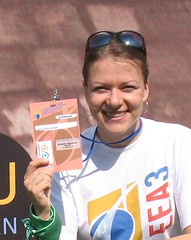
Working for first time as a steward in CCEE/CEC meeting. What to expect?
a word "chaos" has been said and heard several times in the press centre.
Working here has developed some creativity even though not all our tasks are creative in the essence :) the ones who`ve been there know :)
Question: how to divide 30 full boxes of copies paper by paper among 300 journalists in the most efficient, funny, quick, energy-saving etc way?
Answer: just start from number 1 up to number 300 and continue doing so until all the boxes are empty. Well, almost empty. it may turn out that copy-guys have been really enjoying their work as well and made some extra;)
Do not think much while dividing the papers, it may be confusing and in the end you will find yourself in the puzzle of some existential questions. Singing is allowed though!
It has been great pleasure to work for the press centre. honestly.
we had wonderful team and even more wonderful Jane. Thank you for everything :)
Eva
Subscribe to:
Posts (Atom)

 Posts
Posts